Algebraic notation records each move in a few characters. With it you can replay a game after it ends, find the moment where things changed and keep a clear record of the lines you are studying.
You will learn the piece letters, how pawn moves and captures look, what the signs for check and mate mean, how moves are numbered and how a result is marked. A short worked fragment then puts the parts together.
The letters for the pieces
A piece move is written as the piece letter followed by the square where the piece lands. The letters are uppercase. The knight uses N because K already belongs to the king.
| Piece | Letter | Sample move |
|---|---|---|
| King | K | Ke2 |
| Queen | Q | Qd4 |
| Rook | R | Rc1 |
| Bishop | B | Bb5 |
| Knight | N | Nf3 |
| Pawn | no letter | e4 |
Squares are named by a file letter and a rank number. If those names do not come to you at once, practice the board coordinates first, because each move you write depends on them.
So Nf3 reads as knight to f3. The record does not usually say where the knight came from. You work that out from the position: in most cases only one knight can legally get there.
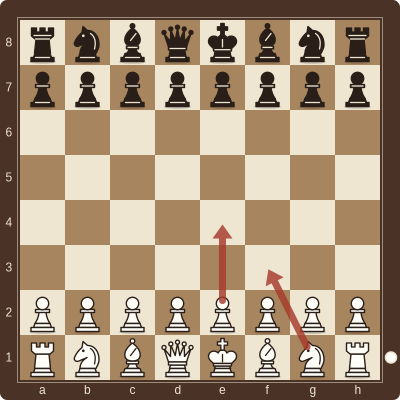
rnbqkbnr/pppppppp/8/8/8/8/PPPPPPPP/RNBQKBNR w KQkq - 0 1Pawn moves and captures
A pawn move is written as the destination square alone. The two characters e4 mean that a pawn moved to e4. There is no piece letter in front.
A capture adds an x before the destination. For a piece it looks like Bxc6: a bishop captures on c6. For a pawn you write the file it came from, then the x, then the square where it lands, as in exd5.
That file letter matters, because two pawns can often capture on the same square. Look at the next position.
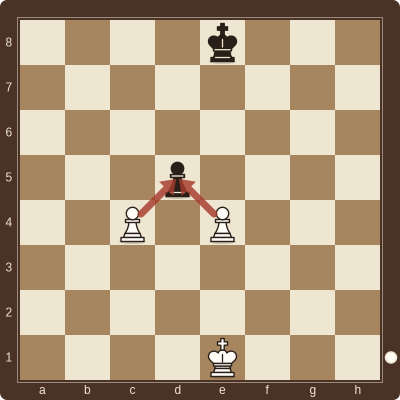
4k3/8/8/3p4/2P1P3/8/8/4K3 w - - 0 1You write the square where the capturing unit ends up, not the name of what was taken. A bishop that captures a knight and a bishop that captures a pawn on that same square are written the same way.
A pawn move also leaves something unsaid. The record does not state whether the pawn advanced one square or two. The position before the move settles it, which is one reason why a record is read in order from a known starting point.
Check, mate and the special moves
A plus sign after a move means that the move gives check. A hash sign means checkmate. Some players write ++ for mate on paper, while computer game files use the hash. The sign always goes at the very end of the move.
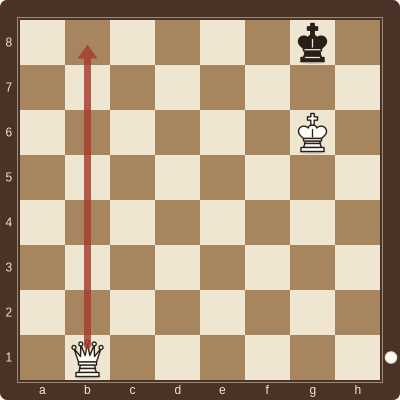
6k1/8/6K1/8/8/8/8/1Q6 w - - 0 1After the queen move, the black king has no square left. The squares f7, g7 and h7 touch the white king, and the queen controls the whole back rank. Compare this with a plain check: a plus sign would mean that Black still had some legal answer.
A check may come from the piece that just moved or from a line that its move has opened. Either way the same plus sign is used.
Three kinds of move have extra writing rules: castling, capturing en passant and promoting a pawn. They are covered in castling, en passant and promotion notation.
One more situation needs care. When two pieces of the same type can reach one square, an extra letter or number tells them apart. The rule is set out in two pieces, one square.
Move numbers and results
A move number covers one turn by White and the reply by Black. Write the number, a full stop, White's move and then Black's move, as in 1. e4 e5. The next pair begins with 2.
If your record starts at a point where Black is to move, or if a note separates the two halves, put three dots after the number: 5... Qe7. The dots show that the White half is not written there.
At the end of a game, add the result. The figure for White always comes first.
| Mark | Meaning |
|---|---|
| 1-0 | White won |
| 0-1 | Black won |
| 1/2-1/2 | draw |
| * | unfinished, or result unknown |
The same marks close games saved as PGN text files. To see how such a file differs from a code for a single position, read FEN compared with PGN.
A short worked fragment
Set up the starting position and play these moves, one numbered line at a time. Say each move aloud before you make it: the piece, then the square. If a move seems impossible, go back and check the move before it.
| Move | White | Black |
|---|---|---|
| 1 | c4 | e5 |
| 2 | d4 | exd4 |
| 3 | Qxd4 | Nc6 |
| 4 | Qd1 | Bb4+ |
| 5 | Bd2 | Qe7 |
- On move 2 the black e-pawn captures on d4, so the move begins with e.
- On move 3 the queen recaptures: Q for the piece, x for the capture, d4 for the square.
- The reply brings a knight to c6, where it attacks the queen, so the queen steps back to d1.
- Black's fourth move puts a bishop on b4 with check, shown by the plus sign.
- White blocks the check with a bishop, and Black brings the queen to e7.
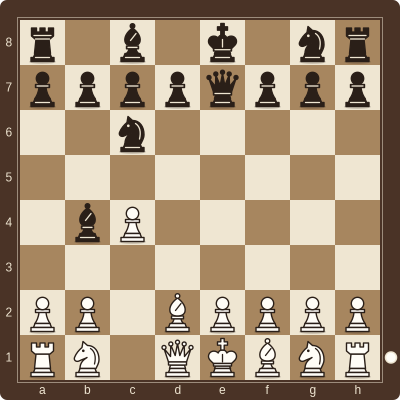
r1b1k1nr/ppppqppp/2n5/8/1bP5/8/PP1BPPPP/RN1QKBNR w KQkq - 5 6Common mistakes when you write moves
- Writing P for a pawn. Pawn moves carry no letter in this notation.
- Wrong case. A lowercase b names a file and an uppercase B names a bishop, so Bxc4 and bxc4 are different moves.
- Adding the starting square out of habit. Normally you record only where the piece goes.
- Forgetting the x. The reader then cannot tell that something left the board.
- Skipping a half move. One missing entry shifts everything after it. Rebuild from the last position you trust.
Before you file a record
- Each move number has a White move, and a Black move unless the game had ended.
- Captures, checks and mate carry their signs.
- The result is written at the end.
- Replaying the record gives the final position you expected.
If you record during a friendly game, write each move as soon as it has been made, so that nothing has to be rebuilt from memory later.
Replaying is the real test. Follow your own record on a board and make sure each move is legal. When one position deserves a closer look, you can rebuild it in the Board builder and save it with a note that gives the move number.
Common questions
Why is the knight written as N?
K is already the letter for the king, so the knight uses the second letter of its name.
What does x mean in chess notation?
It marks a capture. Bxc6 means that a bishop captures the enemy unit on c6.
What is the difference between + and # in a chess move?
The plus sign marks a check that can still be answered. The hash marks checkmate, which ends the game.
How do I write only Black's move?
Write the move number, three dots and then the move, such as 5... Qe7.
Do I need to write which square a piece left?
Usually not. You add that information only when two pieces of the same type could make the move.
Sources
- FIDE Laws of Chess taking effect from 1 January 2023. International Chess Federation (FIDE) Handbook. Rules of movement (Article 3), end of the game (Article 5), recording moves (Article 8), drawn positions (Article 9) and algebraic notation (Appendix C). Consulted on 25 November 2026.
- Portable Game Notation Specification and Implementation Guide. Coordinated by Steven J. Edwards. Standard algebraic notation (section 8.2.3) and the FEN position format (section 16.1). Consulted on 25 November 2026.