A castled king behind three unmoved pawns looks safe. Those same pawns can become its walls. One rook or queen arriving on the last rank can then end the game.
Here you learn the conditions that make the pattern work, how to force a way past a defender, and how to protect your own king before the threat appears.
Four conditions for the pattern
The back rank is the row where a king starts: rank 1 for White, rank 8 for Black. The mate needs all of these at the same time.
- The king stands on its back rank.
- The squares in front of it are filled by its own pieces, usually pawns, or covered by yours.
- A rook or queen of yours can reach that rank and give check.
- The defender cannot capture the checking piece or put anything in between.
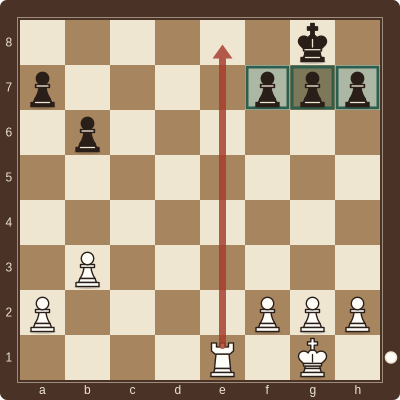
6k1/p4ppp/1p6/8/8/1P6/P4PPP/4R1K1 w - - 0 1Count the king's choices after Re8#. The squares f7, g7 and h7 hold black pawns. The rook covers f8 and h8 along the eighth rank. Black has nothing that can capture on e8 or step between the rook and the king. All four conditions are met.
Read the same list backwards when you are defending. You do not need to break all four conditions. Breaking any one of them is enough to stop this particular mate, so choose the one that is easiest to arrange.
You can spot the danger several moves ahead. Look for a king still behind three pawns, a back rank with no rook on it, and an enemy rook or queen on a file with nothing in the way. When two of these appear together, start counting.
Getting past a single defender
Often one enemy piece still watches the back rank. Count how many of your pieces bear on the entry square and how many of theirs can answer there. If you can bring one more than they can, look for a sequence of captures.
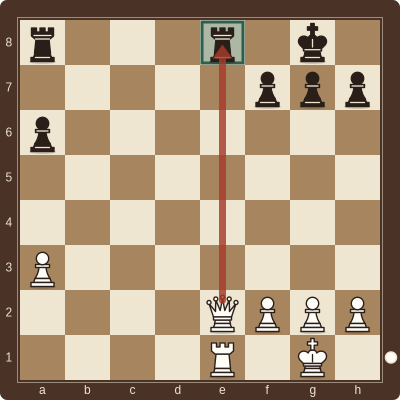
r3r1k1/5ppp/p7/8/8/P7/4QPPP/4R1K1 w - - 0 1White's queen and rook are lined up on the e-file. Black's rook on e8 has one helper, the rook on a8. After 1.Qxe8+ Black must recapture with Rxe8, and 2.Rxe8# ends the game. Giving up the queen for a rook looks poor until you count one move further.
The order is fixed here. The queen stands in front of the rook, so the rook cannot move up the file until the queen has left. Before you calculate such a sequence, check which of your pieces has a clear path right now and which one is still waiting behind it.
The defender here is simply outnumbered. When it can be chased away or lured elsewhere instead, you are using the wider ideas of removing the defender and deflection and decoy.
Make an escape square
The simplest protection is a flight square, often called luft. You advance one of the pawns in front of your king, and the square it leaves becomes a way off the back rank.
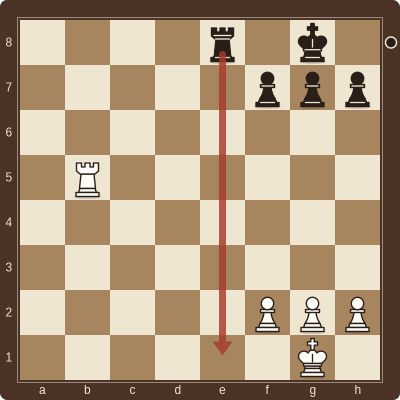
4r1k1/5ppp/8/1R6/8/8/5PPP/6K1 b - - 0 1Suppose it is White's turn instead. A single quiet move, h3, changes the whole picture.
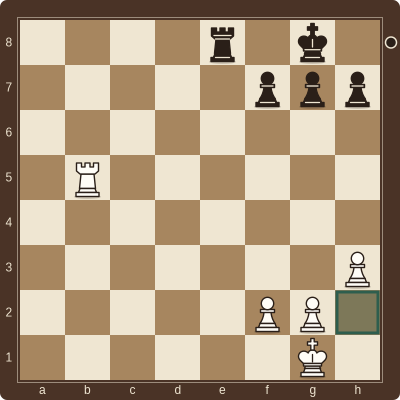
4r1k1/5ppp/8/1R6/8/7P/5PP1/6K1 b - - 0 1Moving the g-pawn can open a square too, on g2. Pick the pawn whose empty square enemy pieces cannot cover, and leave your other two pawns where they shelter the king.
Timing matters because a pawn move cannot be taken back. While many enemy pieces point at your king, a loosened pawn can become a target. A good moment is when files start to open, rooks are about to face each other, and you have a quiet move to spare.
An escape square has to be safe
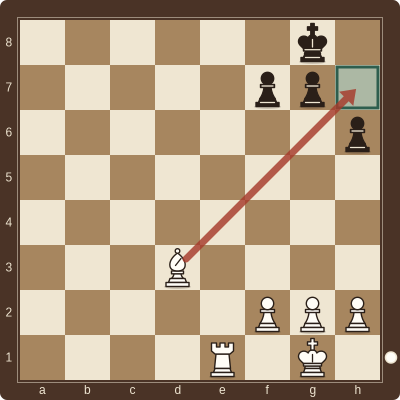
6k1/5pp1/7p/8/8/3B4/5PPP/4R1K1 w - - 0 1A flight square counts only if the king may legally step on it. Look for every enemy piece that covers it, long diagonals included. In this position the line from d3 through e4, f5 and g6 to h7 is open, so the pawn move to h6 did not help at all.
Blocking and other defenses
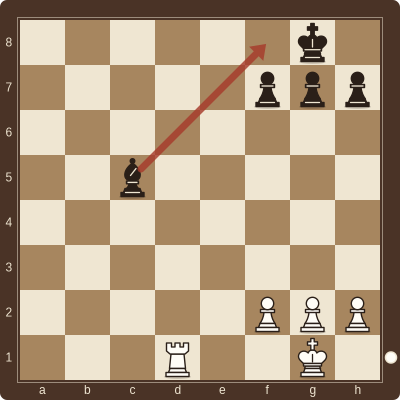
6k1/5ppp/8/2b5/8/8/5PPP/3R2K1 w - - 0 1The block holds because the king protects f8. White could take the bishop with Rxf8+, but after Kxf8 a rook has gone for a bishop. A block by an unprotected piece may only postpone the mate by one move.
Blocking is one of several answers. You can capture the checking piece if one of yours reaches it and is not pinned. Later in a game you can also bring your king up toward the center, which removes the back rank problem altogether.
Compare how long each answer lasts. An escape square keeps helping as long as it stays uncovered. A guard helps only while it stays on duty. A block deals with one check and may leave the next one open.
| Defense | What you do | Check before you rely on it |
|---|---|---|
| Escape square | Advance a pawn in front of your king | Can an enemy piece cover the new square? |
| Guard | Keep a rook or queen watching the entry square | Can that guard be exchanged or drawn away? |
| Block | Put a piece between checker and king | Is the blocking piece protected? |
| Capture | Take the checking piece | Is the capturing piece pinned or needed elsewhere? |
| Remove the attacker early | Exchange the rook or queen before it arrives | Does the exchange leave another piece loose? |
Common mistakes
- Leaving the rank empty while the opponent still has a rook or queen and an open file to use.
- Trusting one lone guard. A single defender can be exchanged or lured away.
- Pushing the wrong pawn. A new square that an enemy piece covers is no escape.
- Checking before counting the blocks. A check that can be met by a protected piece may only lose you time.
- Looking at one king only. While you plan the blow on their rank, your own can be just as weak.
A short routine before you move
Back rank check
Run this for both kings whenever heavy pieces share an open file.
- Can either king be checked along its back rank soon?
- Does that king have a square off the rank that it may legally use?
- How many pieces bear on the entry square, and how many defend it?
- Can a defender be exchanged or drawn away?
A close relative of this pattern is the smothered mate, where a knight strikes a king boxed in by its own pieces. If you are unsure whether a final position is really mate, review how to tell checkmate from stalemate.
Positions from your own games make the best drills. Rebuild one in the Board builder, tag it as back rank, and print a sheet once several have piled up.
Common questions
What does luft mean in chess?
It is a square you create for your king, usually by advancing a pawn in front of it, so that a check on the back rank can be escaped.
Which pawn should I move to prevent back rank mate?
The h-pawn is a common choice, but the right pawn is the one whose empty square no enemy piece can cover.
Can a queen give a back rank mate?
Yes. A queen or a rook can do it, since both attack along a rank.
Can Black be mated this way as well as White?
Yes. The pattern is the same on rank 1 for a white king and on rank 8 for a black king.
Sources
- FIDE Laws of Chess taking effect from 1 January 2023. International Chess Federation (FIDE) Handbook. Rules of movement (Article 3), end of the game (Article 5), recording moves (Article 8), drawn positions (Article 9) and algebraic notation (Appendix C). Consulted on 25 November 2026.