A study notebook is not a record of everything you play. It is a short stack of positions, each holding one thing you want to remember.
This page helps you choose what to keep, write an entry you can still understand next month, build a weekly habit and protect your work.
What deserves a place
Keep a position when it changed how you see something. Typical cases are a chance you missed, a mistake you made, an idea you found and want to repeat, or a moment where you could not decide. A position that felt ordinary and taught nothing can go.
Three questions sort the candidates quickly. Did the position surprise you? Would you play something different now? Can you name the idea in a few words? A yes to two of them is a good reason to keep it.
Save the board just before the decisive moment, not after it. When you come back, you want to face the same question again and not look at the answer.
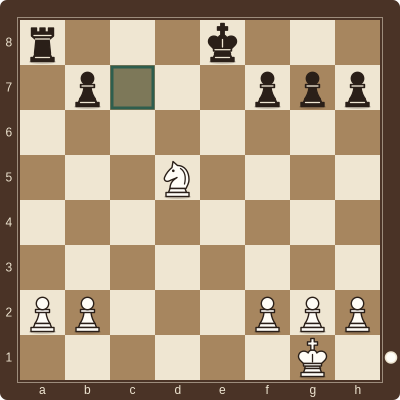
r3k3/1p3ppp/8/3N4/8/8/PP3PPP/6K1 w - - 0 1If you missed this fork in a game, the saved board shows the exact shape: two targets that one knight jump can reach at once.
One position, one lesson
Give each entry a single point. If a game taught you two things, save two positions. A note that tries to cover the opening, the tactic and the ending at once will not be read.
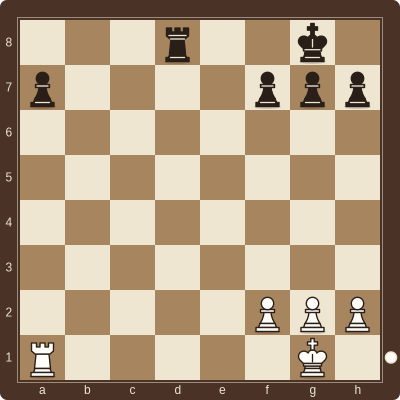
3r2k1/p4ppp/8/8/8/8/5PPP/R5K1 w - - 0 1The lesson here is short: before taking the pawn on a7, look at your own back rank. The greedy Rxa7 allows Rd1#, because the white king has no square to flee to. One sentence like that is enough.
Title, note, tags and side to move
| Field | What goes in | Example |
|---|---|---|
| Title | A neutral name that hides the answer | Pawn on a7: take it? |
| Note | The idea in one or two sentences | My king had no way out |
| Tags | One or two labels | back rank, endgame |
| Side to move | Whoever has the decision | White |
The side to move is part of the position, not a detail. Change it and you may have a different problem with a different answer, as these two boards show.
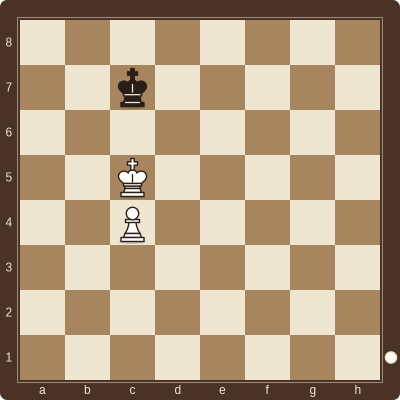
8/2k5/8/2K5/2P5/8/8/8 w - - 0 1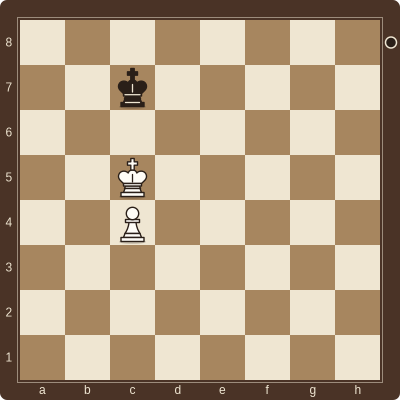
8/2k5/8/2K5/2P5/8/8/8 b - - 0 1Every piece stands on the same square in both. When Black has to move, the black king must give ground and White gets through. A notebook entry without the correct side to move would teach you the wrong thing.
Write the note for a reader who has forgotten the game. Say what you thought, what was true and what you will look for next time. Skip move lists you can reconstruct from the board.
A weekly routine you can keep
- After a game, mark one or two moments that surprised you.
- Set up each position and check every piece against your memory or your score sheet.
- Set the side to move, then save it with a title, a note and a tag or two.
- At the end of the week, reopen the new entries and solve them before reading the notes.
- Export a copy of the notebook so there is a backup.
Small and regular beats large and rare. Two entries a week, reviewed, are likely to teach you more than thirty saved in one evening and never opened again. For a review system with tags and growing gaps, see tagging and reviewing positions.
A sample entry
This is how the knight position above could be recorded.
- Title: Knight on d5, what now?
- Side to move: White.
- Note: A king and a loose rook can both be hit by one knight jump. Look for knight checks first.
- Tags: fork, endgame.
A week without games is not a problem. Use the time to go back through older entries, fix titles that give too much away and delete duplicates. Ten minutes of tidying keeps the notebook pleasant to open.
Using the notebook in the Board builder
In the Board builder you can drag pieces or place them with the keyboard, set the side to move, castling rights and en passant square, or paste a FEN to import a position. Save it with a title, note and tags. The notebook has search, a tag filter, rename and delete, and you can copy the FEN of any saved position.
You can also flip the board to look at a position from the other side, which helps when you played Black. A diagram can be downloaded as a PNG picture, handy for sending a single question to a study partner.
The notebook lives only in the browser you are using. There is no account and no sync between devices. If you switch browser or clear the stored site data, do not expect your positions to be there.
Back up by exporting the notebook as a text file of all positions and their FEN strings. A FEN is a one line description of a position; the FEN field guide explains it. To move a position to another device, copy its FEN and paste it into the Board builder there. If your notes matter, keep a copy of them in a document of your own too.
A FEN stores one position, not the moves that led to it. If you want to keep a whole game, read FEN versus PGN. For turning saved boards into handouts, see printing diagrams for lessons.
Pick a fixed moment for the export, such as the last review of the month, and put the date in the file name. An old backup is far better than none.
Common mistakes with study notebooks
- Saving everything. A crowded notebook hides the entries that matter.
- Writing an essay. Long notes are skipped when you review.
- Leaving the wrong side to move. The problem changes with it.
- Putting the answer in the title. You will remember the label and skip the thinking.
- Never exporting. Clearing the browser data can remove the only copy.
Before you save
- Every piece is on the right square.
- The side to move is set.
- The title does not give the answer away.
- The note states one idea.
Common questions
What should I put in a chess study notebook?
Positions that taught you something: missed chances, your own errors and ideas you want to repeat, each with a short note and the side to move.
Where are my saved positions stored?
Only in the browser you used to save them. There is no account, so export a text copy if you want a backup.
Can I use my notebook on another device?
It does not sync. Copy a position's FEN, or take it from the exported text file, and paste it into the Board builder on the other device.
Does the Board builder analyze my positions?
No. It has no analysis engine and suggests no moves, so you check your ideas yourself or with a study partner.
Sources
- Portable Game Notation Specification and Implementation Guide. Coordinated by Steven J. Edwards. Standard algebraic notation (section 8.2.3) and the FEN position format (section 16.1). Consulted on 25 November 2026.