A notebook grows quickly. Without a way to find entries and come back to them, the older ones are forgotten.
This page sets up a small set of tags and a review rhythm that fits in a few minutes a week. Choosing which positions to save is covered in keeping a study notebook.
Three kinds of tag
Tags are short labels that let you pull up related positions together. Three kinds cover most needs: what the position is about, where in the game it comes from and what a correct answer reaches.
| Group | Example tags | Question it answers |
|---|---|---|
| Idea | pin, fork, back rank, square rule | Which pattern is here? |
| Phase | opening, middlegame, endgame | When does it happen? |
| Result | mate, wins material, win, draw | What should I reach? |
Give each position one tag from the idea group and one from the phase group. Add a result tag when it helps you check your answer. More than three tags on one board usually means the entry holds more than one lesson.
Pick a spelling and stick to it. If you write pin on one entry and pins on another, you may end up with two labels and miss some examples when you filter. A short written list of your allowed tags prevents that.
Start with fewer tags than you think you need. It is easy to add a new one after you notice a gap, and tedious to repair a long list of near duplicates.
Tag by idea
Idea tags are the most useful, because they group positions that look different but work the same way. Name the mechanism, not the pieces.
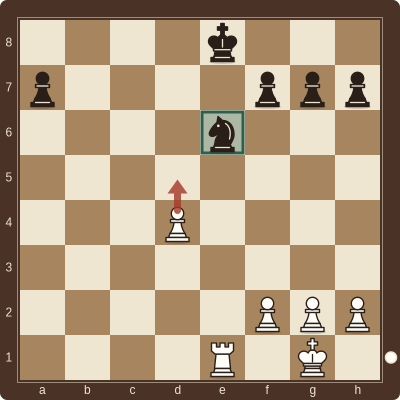
4k3/p4ppp/4n3/8/3P4/8/5PPP/4R1K1 w - - 0 1The pinned knight cannot move, so the pawn push d5 hits a target that cannot run. Tagged with pin, this entry will sit next to other pins even when the pinning piece is a bishop or a queen. The page on pins explains absolute and relative cases.
Tag by phase and result
Phase tags help when you want a session on endings only. Result tags tell you the goal without telling you how, so they are safe to read before solving. Avoid a result tag if it gives the whole puzzle away.
The border between opening, middlegame and endgame is not exact. Pick your own rule once, for example endgame when the queens are gone and few pieces remain, and apply it the same way each time. Consistency matters more than precision.
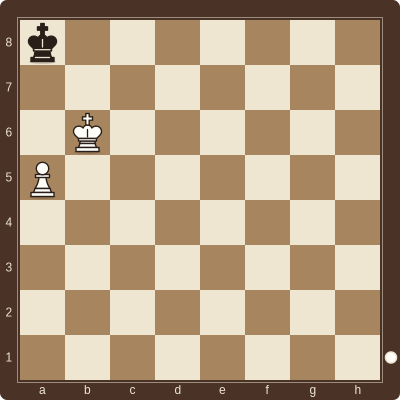
k7/8/1K6/P7/8/8/8/8 w - - 0 1Here White cannot force the pawn through, and a draw tag reminds you that the right answer is to find out why. When you review, try to push the black king out of the corner and see what stops you.
Review with the note covered
Reading a note is not the same as knowing it. Look at the board first, cover the note with your hand or a card, and say your answer before you uncover it. If you cannot explain why, count it as missed.
Before moving any piece, name the threats on both sides. Then choose your move and picture the reply. Only after that compare your answer with the note. This order stops you from playing the first idea that looks nice.
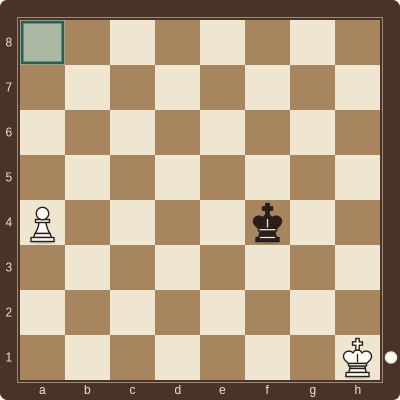
8/8/8/8/P4k2/8/8/7K w - - 0 1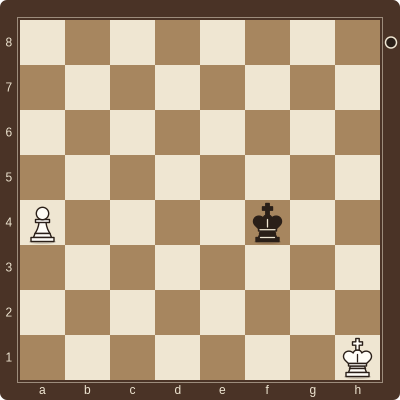
8/8/8/8/P4k2/8/8/7K b - - 0 1Both boards share the tags endgame and square rule, with different result tags: a win for White after a5, a draw for Black after Ke5 or Ke4. Reviewing them as a pair trains you to check the side to move. The method behind them is in the square of the pawn.
A ten minute review
- Filter by one tag and choose three or four positions.
- Read the side to move before anything else.
- Cover the note and give your answer aloud.
- Uncover it, then mark the position as solved or missed.
Space the reviews
Spaced repetition, in plain words, means looking at something again after a short gap, then after longer and longer gaps while you keep getting it right. When you miss it, the gap becomes short again. The aim is to meet each position shortly before you would forget it.
| After | If you solve it | If you miss it |
|---|---|---|
| 1 day | Wait 3 days | Repeat tomorrow |
| 3 days | Wait 1 week | Repeat tomorrow |
| 1 week | Wait 2 weeks | Go back to 3 days |
| 2 weeks | Wait 1 month | Go back to 1 week |
These intervals are a starting point, not a law. Shorten them if you keep failing and lengthen them if reviews feel automatic. Your positions can be kept in the Board builder, but it does not schedule reviews, so put the next date on a paper list or rename the entry to include it.
Keep each session short, and stop while you still enjoy it. A routine of a few positions several times a week survives busy periods better than one long sitting.
Retire positions
A position is ready to retire when you solve it several times in a row after long gaps and can explain the idea in your own words. Keeping it in the daily pile only takes time from the ones you still miss.
You can rename it with a mark such as done, so it is easy to spot, or delete it. Export the notebook first if you may want it again: the text file holds the FEN of each position, which you can paste back in later. A retired position can still make a good handout, so see printing diagrams for lessons before you delete one.
Common mistakes with tags and reviews
- Making a tag for every detail. A tag that never collects a second position helps nobody.
- Using two words for one idea. Merge them early, before the list grows.
- Reading the note first. You will recognize the answer without finding it.
- Reviewing everything every time. Choose by date or by tag and keep it short.
- Never retiring anything. The pile grows until you stop opening it.
When a tag collects many positions, resist splitting it right away. Look at them side by side first. Often the differences are small enough that one clear note per entry does the job.
Missed positions deserve a second look at the note too. If you failed because the note was unclear, rewrite it on your paper list in your own words before the next review.
Common questions
How many tags should a chess position have?
Two or three: one for the idea, one for the phase and, if useful, one for the result you should reach.
How often should I review saved positions?
Start the next day, then widen the gaps as you keep solving them. A short session a few times a week is easier to keep than a long one.
What is spaced repetition?
Reviewing something again after growing gaps while you remember it, and shortening the gap when you do not.
Should I delete positions I already know?
You can retire them. Rename them with a mark, or export the notebook before deleting so you can paste a FEN back later.
Sources
- Portable Game Notation Specification and Implementation Guide. Coordinated by Steven J. Edwards. Standard algebraic notation (section 8.2.3) and the FEN position format (section 16.1). Consulted on 25 November 2026.