Some passed pawns win the game without ever becoming a queen. Their job is to be so far away that the enemy king has to walk a long way to deal with them.
You will learn to recognize such a pawn, to time the moment you give it up, and to spot the positions where the idea only draws. The method needs patience more than calculation, but the final count still matters.
What makes a passed pawn outside
A pawn is passed when no enemy pawn can stop it: none stands ahead of it on its own file or on the files next to it. It is outside when it sits far to one side, away from the pawns where the real fight will happen.
Distance is what counts. A passed pawn on the a file with the other pawns on the g file is very much outside. A passed pawn right next to them is not, because one king can watch everything from the same spot.
To find a candidate, look for a wing where you have more pawns than your opponent. If one of those pawns can get through and the rest of the play is on the other side, you may be building the runner you want.
| Kind | What it looks like | Main use |
|---|---|---|
| Ordinary passed pawn | No enemy pawn in its way | Heads for promotion |
| Outside passed pawn | Passed and far from the other pawns | Pulls the enemy king away |
| Protected passed pawn | Passed and defended by one of your pawns | Holds the enemy king while yours roams |
The decoy: push it and let them come
In this position the a pawn is the outside passer. The g pawns face each other and cannot move.
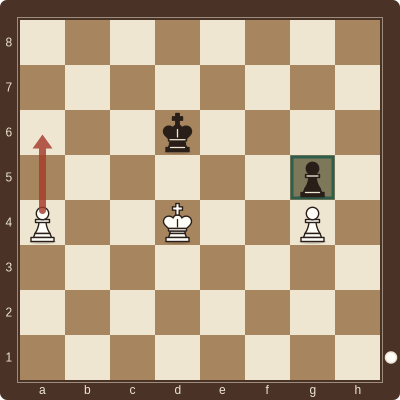
8/8/3k4/6p1/P2K2P1/8/8/8 w - - 0 1Play it through: 1.a5 Kc6 2.a6 Kb6 3.Ke5. Notice the third move. White does not defend the a pawn. The king turns toward the other side while the black king is still busy.
The black king must deal with the runner, or it will queen. To see whether a king arrives in time, draw the square of the pawn. Here every step toward the a file is a step away from g5.
Then collect the other side
Here is the position three moves later, after the black king has taken the bait.
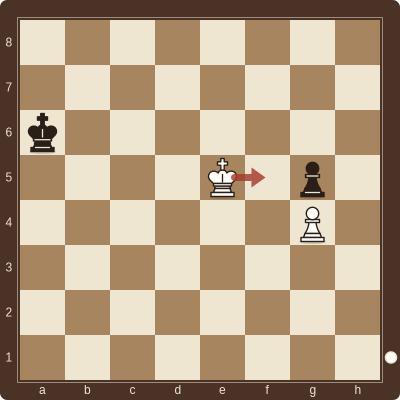
8/8/k7/4K1p1/6P1/8/8/8 w - - 0 4After 4.Kf5 Kb6 5.Kxg5 White has a king in front of its own pawn and the black king is several steps behind. The extra pawn will now queen.
Count the distance
Look again at the last diagram and count king moves.
- The white king needs two moves to capture on g5, going through f5.
- The black king on a6 needs five moves just to stand next to g5.
- That gap is the head start the runner gave you, and it is why White arrives first.
The trick also works if the black king stays back and meets the pawn late. In the line 1.a5 Kd7 2.a6 Kc7 3.a7 Kb7 4.a8=Q+ Kxa8, White gives up a brand new queen. It sounds odd, yet the black king ends in the far corner, a long walk from the g pawns, and White still wins.
Before you give up the passer
Count these on the board, not in a hurry.
- How many moves does the enemy king need to capture the runner?
- How many moves does it need to get back?
- How many moves does my king need to reach the other pawns?
- After I win them, can one of my pawns still queen?
Contrast: the protected passed pawn
A protected passed pawn works differently. You do not offer it. It stands safely and the enemy king must keep watch.
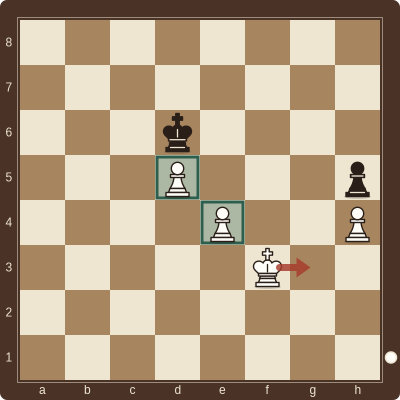
8/8/3k4/3P3p/4P2P/5K2/8/8 w - - 0 1One winning path is 1.Kg3 Kd7 2.Kf4 Kd6 3.Kg5 Ke5 4.Kxh5. If Black now tries 4...Kxe4, the guard is gone but 5.d6 sends the passed pawn on its way and the black king cannot catch it.
The black king cannot simply take d5, because e4 defends it. It cannot wander far either, or the pawn walks forward. So the outside passer does its work by being given up at the right moment, while the protected one does it by staying on the board.
When the outside passer is not enough
Compare two positions that differ only in the file of the other two pawns. In both, White has the b pawn as the runner.
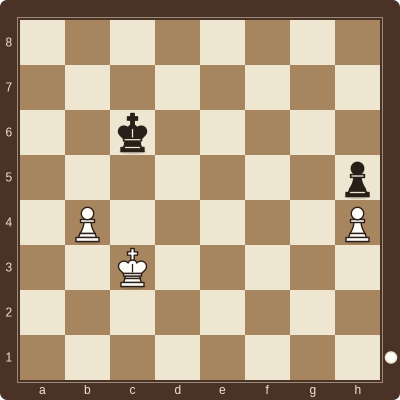
8/8/2k5/7p/1P5P/2K5/8/8 w - - 0 1White wins the h5 pawn after 1.Kd4 Kb5 2.Ke4 Kxb4 3.Kf5 Kc5 4.Kg5 Kd6 5.Kxh5. The black king runs back: 5...Ke7 6.Kg6 Kf8. It gets close enough to the corner in time, and a lone rook pawn cannot break through.
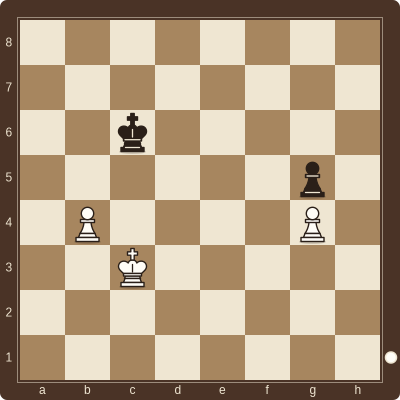
8/8/2k5/6p1/1P4P1/2K5/8/8 w - - 0 1After 1.Kd4 Kb5 2.Ke4 Kxb4 3.Kf5 Kc5 4.Kxg5 the remaining pawn is a g pawn, and the black king is too late. One file made the difference.
Other reasons for failure are just as concrete: your king stands too far from the other pawns, or the opponent has a runner of their own. When both sides have runners, count the way you would in pawn races.
Common mistakes with a distant runner
- Defending the passer with your king. Your king belongs with the other pawns. The runner has already done its work once the enemy king goes after it.
- Pushing it too late or too early. Push when your king can reach the targets before the enemy king can come home.
- Forgetting what remains. If only a rook pawn will be left, check the corner before you commit.
- Ignoring other plans. Sometimes a pawn breakthrough on the other side is quicker.
The idea often starts earlier, when you choose which pieces to swap. A distant pawn majority can be a reason to head for a pawn ending, but only after checking the swap first.
To rehearse, enter the two b pawn positions in the Board builder, save both with a note about the difference, and replay them a week later without looking at the note.
Common questions
What is an outside passed pawn?
It is a passed pawn far to one side of the board, away from the other pawns. Its main strength is that it forces the enemy king to travel.
Should I always give up the outside passed pawn?
No. Give it up only when your king gains more on the other side than the enemy king gains by capturing it. Count the moves first.
Which is better, an outside or a protected passed pawn?
They do different jobs. The outside one drags the king away, and the protected one keeps it tied down. The position decides which matters more.
Sources
- FIDE Laws of Chess taking effect from 1 January 2023. International Chess Federation (FIDE) Handbook. Rules of movement (Article 3), end of the game (Article 5), recording moves (Article 8), drawn positions (Article 9) and algebraic notation (Appendix C). Consulted on 25 November 2026.
- lila-tablebase: tablebase server based on Syzygy tables. Lichess open source project. Used to check the result of endgame positions with few pieces. Consulted on 25 November 2026.