Once the final pieces come off, you cannot call them back. A pawn ending can be a clear win or a dead draw, and the difference may be a single square for one king.
This page shows what to work out before you capture, using positions where the same exchange wins in one setup and only draws in another.
Why this swap is different
Most exchanges leave you something to repair a mistake with. After the last queens, rooks, bishops or knights are gone, only kings and pawns remain, and new pieces can appear only through promotion. Kings become fighting pieces and every tempo, meaning every single turn, counts.
That is good news if you calculate. With so little on the board, you can often follow the whole line to the end. It is bad news if you swap on feel, because an extra pawn alone does not promise a win.
Treat the capture as the first move of the new ending, not as the end of the old one. If you cannot see how that ending goes, keeping the pieces is usually the safer choice.
The same swap, two results
In both boards below White has a rook and a pawn against a rook, and can play the same capture. Only the white king is placed differently.
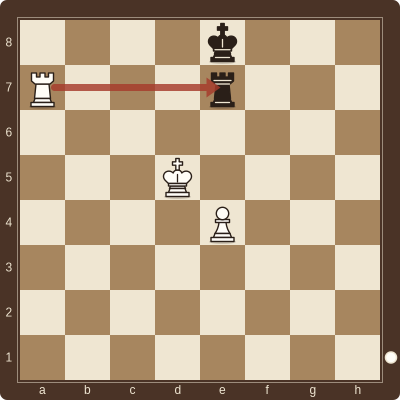
4k3/R3r3/8/3K4/4P3/8/8/8 w - - 0 1After Rxe7+ Kxe7 it is White's turn, the white king stands ahead of the pawn, and Ke5 takes the opposition. The kings face each other with one square between them and Black must give way. That is a won ending.
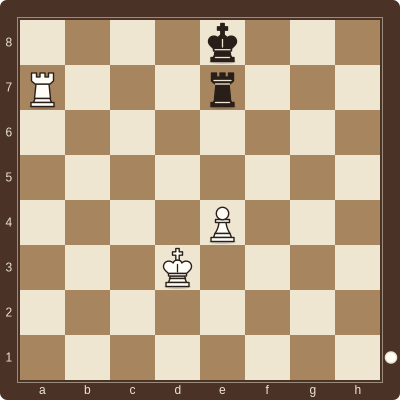
4k3/R3r3/8/8/4P3/3K4/8/8 w - - 0 1Here the black king gets in front of the pawn in time. Neither the swap nor any other move wins. The material is identical to the first board; the result changed because one king was late. The page on key squares shows which squares your king must reach to be early enough.
Count whose move it is
A capture and a recapture change the turn in a fixed way: if you take and your opponent takes back, you move first in the ending. If you only recapture, they move first. In many king and pawn positions this decides everything.
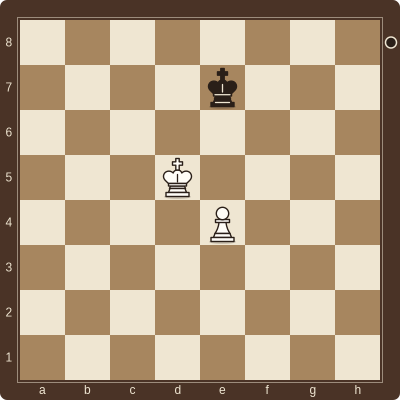
8/4k3/8/3K4/4P3/8/8/8 b - - 0 1These are the squares you saw after the winning exchange. With Black to move, Kd7 holds: it takes the opposition, so now White has the awkward turn. This is the opposition in practice, and it is why you should name the side to move before judging the position.
Passed pawns and king distance
Next, look for pawns with a free road. A passed pawn far from the rest of the play can drag the enemy king away while your own king collects pawns elsewhere.
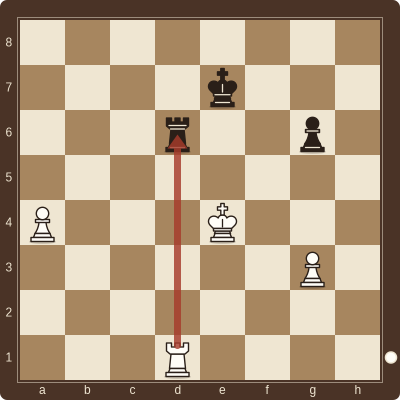
8/4k3/3r2p1/8/P3K3/6P1/8/3R4 w - - 0 1After Rxd6 Kxd6 the a-pawn is on the far wing. One natural line runs a5 Kc6 Kf4 Kb5 Kg5 Kxa5 Kxg6: Black rounds up the runner, but meanwhile the white king takes g6 and the g-pawn can no longer be stopped. This is the outside passed pawn at work.
Other moves also win from the diagram, so the swap is one good road, not the only one. When several moves win, choose the one whose follow-up you can see most clearly.
Counting moves on that board
Count in king moves and pawn moves after the exchange on d6:
- The a-pawn on a4 needs four moves to promote.
- The black king on d6 can reach a8 in three, so it can catch the pawn.
- Catching it takes the black king to the far wing, away from its own g-pawn.
- The white king needs three moves, Kf4, Kg5 and Kxg6, to collect that pawn.
A count like this takes a minute. It tells you not only whether the runner is caught but also where the kings will be when it is.
Which king gets there first
In an ending with no pieces, the king is your strongest fighter. Before you swap, find the squares each king wants: in front of your own pawns, next to the enemy pawns, and on the path of any runner. Then count the moves to get there, remembering that a king cannot step next to the other king or onto a square an enemy pawn attacks.
A king that already stands near the center is usually the better placed one. A king still tucked in its corner after castling may need many moves to join in. If your king is far and theirs is close, the same pawns can turn from an advantage into targets.
Also note who has pawn moves in reserve. A pawn still on its starting square can move one or two squares, which gives you a choice about when and how you pass the turn. Once all your pawns have advanced as far as they can, only the king can make that waiting move.
What to count before you swap
| Check | Question | Why it matters |
|---|---|---|
| Turn | Who moves first? | Can flip the result |
| Kings | Which king gets forward first? | Decides who controls the key squares |
| Passed pawns | Can a pawn run alone? | A free runner may end the game |
| Distance | How far is each king from the pawns? | A late king cannot help |
| Spare moves | Who has pawn moves left? | A waiting move can win the opposition |
| Edge pawns | Is the extra pawn on the a- or h-file? | These often draw |
Before the last exchange
- I set the position up as it will look after the recapture.
- I said out loud which side moves.
- I traced both kings toward the pawns, square by square.
- I looked for a way to keep the pieces and stay better.
If any step is unclear, wait. A rook or minor piece ending may give you more chances than a pawn ending you do not understand. The idea of keeping a lead safely is covered in how to simplify when ahead.
Common mistakes before the swap
- Swapping because you are a pawn up. Plenty of such endings are drawn against correct defense.
- Forgetting the turn. Picture the exchange, then ask who moves next.
- Ignoring king distance. A pawn that your king cannot support may simply be taken.
- Missing the enemy runner. Your opponent's passed pawn counts as much as yours.
- Calculating only one king path. Try the side road and the straight one.
One more habit helps: calculate the exchange from your opponent's chair too. Ask whether they can choose a different recapture, or decline the swap and keep a better version of the position. A swap you cannot force is only an offer, so check what happens if it is turned down.
To train this, save positions where a swap was possible in the Board builder and note your verdict. Then set up the pawn ending after the capture and play it out against a partner from both sides.
Common questions
Should I trade rooks when I am a pawn up?
Only after you have checked the pawn ending that follows. Some are won, and others are drawn if the defender plays correctly.
How do I calculate a pawn ending before the swap?
Picture the board after the recapture, note who moves, then follow the king paths and any pawn race a few moves deep.
Is an extra pawn enough to win a pawn ending?
Not always. The kings, the side to move and the file of the pawn can each turn a win into a draw.
Why is the last piece exchange so final?
Captured pieces do not come back, and new ones appear only if a pawn promotes. Whatever shape remains, you must play it with kings and pawns.
Sources
- FIDE Laws of Chess taking effect from 1 January 2023. International Chess Federation (FIDE) Handbook. Rules of movement (Article 3), end of the game (Article 5), recording moves (Article 8), drawn positions (Article 9) and algebraic notation (Appendix C). Consulted on 25 November 2026.
- lila-tablebase: tablebase server based on Syzygy tables. Lichess open source project. Used to check the result of endgame positions with few pieces. Consulted on 25 November 2026.