A single piece can protect two things at once, right up to the moment it is asked to act. When it moves to deal with one, the other is abandoned. That piece is overloaded.
You will learn to write down a defender's duties, test them one at a time on rook and queen examples and, when the busy piece is yours, find a way to lighten its load.
What overload looks like
Overload is not about how strong a piece is. A queen can be overloaded as easily as a knight. What matters is that two or more important things depend on it, and that it can only make one move at a time.
The usual duties are protecting a piece, covering an entry square near the king, guarding the last rank and blocking a line. Any two of these on one defender are a signal to look closer.
The method has three steps. Find a busy defender, list what depends on it, then make it respond to one duty and collect on the other.
Jobs tend to pile up as a game goes on. Each exchange removes a possible helper, and the pieces that remain inherit more to watch. After any swap near your target, look again at who is now doing what.
Positions with a king stuck behind unmoved pawns are a good place to start. There the last rank itself becomes a duty, and one rook or queen is often the only piece performing it.
List the duties first
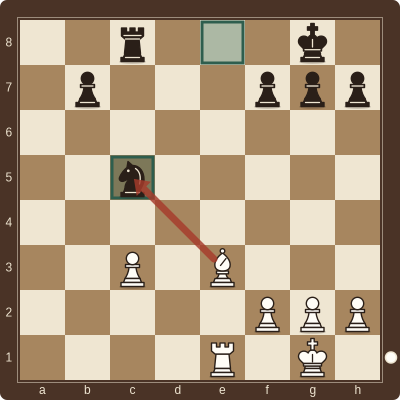
2r3k1/1p3ppp/8/2n5/8/2P1B3/5PPP/4R1K1 w - - 0 1| Black piece | Duty | How to test it |
|---|---|---|
| Rook on c8 | Protects the knight on c5 | Capture on c5 and see who recaptures |
| Rook on c8 | Answers a rook check on e8 | Ask what Re8 would do without it |
| King on g8 | Cannot leave the last rank | All three squares in front of it are filled |
Black's rook has two jobs. The king is hemmed in by its three pawns, so only the rook can answer a rook check on the back rank.
To build such a list yourself, take one enemy piece at a time. Trace every line or jump it controls and stop wherever there is something of its own. Then trace the squares near its king where you would like to give check. Anything it alone covers goes on the list.
An overloaded rook
Now test the first duty with Bxc5. If Black recaptures with Rxc5, the rook has left the last rank and Re8# ends the game. The same bishop move also clears the e-file, which is why the mate was not available before.
So Black cannot recapture. A sensible reply is h6, giving the king an escape square. White then simply retreats the bishop with Bd4, having won a whole knight. The overload has won material even though no mate happened.
The two duties were tested in two different ways. The knight was tested by a capture, and the last rank by the threat of a check. Behind the check stands mate, which is why the rook cannot let go of that job even for one turn.
Notice the order. Take the thing the defender guards, and let it choose which job to drop. You want every choice to hurt.
A capture or a check makes a sharp test because the opponent cannot simply ignore it. A quiet threat leaves time to bring up a second defender, and then the overload disappears before you can use it.
An overloaded queen
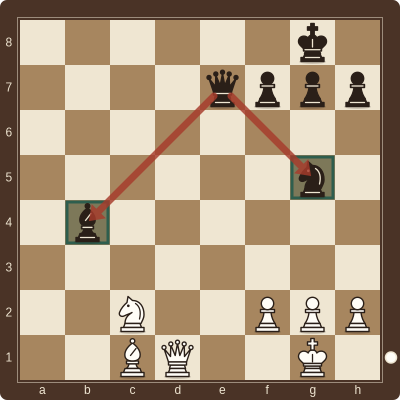
6k1/4qppp/8/6n1/1b6/8/2N2PPP/2BQ2K1 w - - 0 1The queen on e7 looks along one diagonal to b4 and another to g5. White can start at either end. Play Nxb4, and after Qxb4 the queen no longer sees g5, so Bxg5 wins a knight.
The other order also works: Bxg5 Qxg5 and then Nxb4 takes the bishop. In both cases the first capture is an even swap and the second is pure gain.
Check this every time, because in many positions only one order works. A recapture may land the defender on a square from which it still covers the second target. Follow each recapture to its new square and look again.
Relieving the load
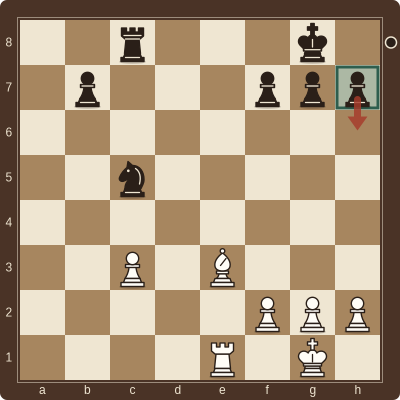
2r3k1/1p3ppp/8/2n5/8/2P1B3/5PPP/4R1K1 b - - 0 1With the move, Black plays h6. Now Bxc5 can be answered by Rxc5, because after Re8+ the king walks to h7. The exchange is even and the problem is gone.
There are three general cures: give one duty to another piece, make an escape square so a mating threat no longer ties anyone down, or move the guarded piece to a safer place.
Do it before the test arrives. Once the capture is on the board, the quiet repair comes too late: in the rook example, h6 played after Bxc5 does not win the knight back. A good time to check your own defenders is right after you have moved a piece away from their side of the board.
Common overload mistakes
- Counting a piece as defended without asking what else its defender must do.
- Capturing in the wrong order, so the recapture keeps both duties covered.
- Missing that the defender has a second piece helping it.
- Leaving your own back rank weak while you attack theirs.
Overload scan
- Which enemy piece protects two or more things?
- Which of those can I attack with a capture or check right now?
- Where does the defender end up after it responds?
- Is the second target still protected from there?
- What happens if the opponent ignores the first capture?
Overload is a close neighbor of removing the defender and deflection. A defender that is also under a pin has even less freedom, and an in-between move by the defending side is a common way a plan like this goes wrong. Keep your best finds in the Board builder with the two duties written in the note.
Common questions
What does overloaded mean in chess?
It means one piece is responsible for more defensive jobs than it can keep up when attacked. Dealing with one leaves another undone.
Which pieces get overloaded most?
Queens and rooks often do, because they can cover distant squares and are asked to hold several things. Any piece, including the king, can be overloaded.
How can I avoid overloading my own pieces?
Spread defensive duties around, give your king an escape square and check what each guard is doing before you rely on it.
Is overload the same as a fork?
No. A fork is two threats from one of your pieces. Overload is two jobs held by one of your opponent's pieces, which you test one after the other.
Sources
- FIDE Laws of Chess taking effect from 1 January 2023. International Chess Federation (FIDE) Handbook. Rules of movement (Article 3), end of the game (Article 5), recording moves (Article 8), drawn positions (Article 9) and algebraic notation (Appendix C). Consulted on 25 November 2026.