A pin happens when a piece stands between an enemy attacker and something more important behind it. The front piece either may not leave the line or would be sorry if it did.
Use the positions here to tell the two kinds of pin apart, add a second attacker to a stuck piece and find a way out when the pinned piece is yours.
What a pin is made of
Three things stand on one line. First the attacker, then the pinned piece, then the target behind it. The line can be a rank, a file or a diagonal, and nothing else may stand in the gaps.
Only pieces that move along lines can pin: the queen on any line, the rook on ranks and files, the bishop on diagonals. A knight, a pawn or a king can attack a pinned piece, but it cannot create the pin.
Pins show up in predictable places. Bishops arriving on b5 or g5 often catch a knight standing on c6 or f6. A rook on an open file can freeze whatever stands in front of the enemy king. Whenever two enemy pieces line up, ask which of your line pieces could look down that line.
| Question | Absolute pin | Relative pin |
|---|---|---|
| What stands behind? | The king | A queen, rook or other target |
| May the pinned piece leave the line? | No, the rules forbid it | Yes, the move is legal |
| What happens if it leaves? | It cannot happen | The piece behind can be captured |
| How to punish it | Attack the stuck piece again | Attack it again, or wait for it to move |
Absolute pins: the king stands behind
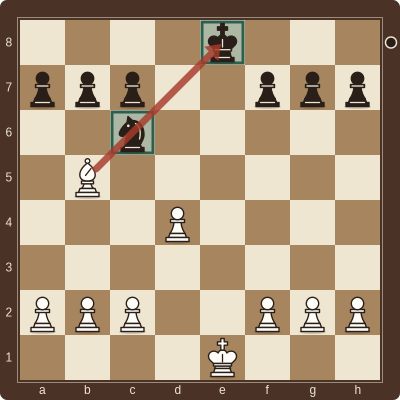
4k3/ppp2ppp/2n5/1B6/3P4/8/PPP2PPP/4K3 b - - 0 1Follow the diagonal from b5 through c6 and d7 to e8. If the knight left, the black king would be in check, so the rules do not allow the move.
Look at d4. The knight points at that pawn, yet it cannot take it. A pinned knight is frozen completely, because a knight jump can never stay on the line. A pinned queen may still slide along the pin line, and so may a rook or bishop if that line is one it moves on. It may even capture the pinner.
One detail catches many players. A pinned piece still gives check and still guards squares against the enemy king. Your king may not step onto a square it covers, even though that piece could not legally travel there.
Relative pins: legal, but painful
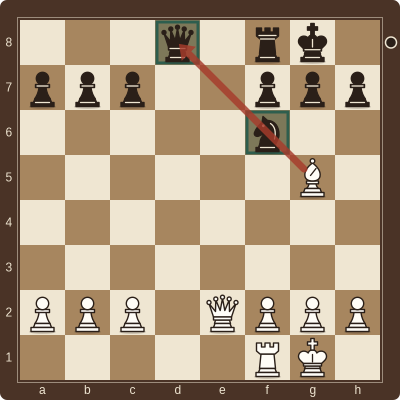
3q1rk1/ppp2ppp/5n2/6B1/8/8/PPP1QPPP/5RK1 b - - 0 1The knight on f6 has six legal moves here. Play Ne4 and the answer is Bxd8. Black can recapture the bishop, but has still given up a queen for it, and the queen is far stronger. After Rxd8, Qxe4 even takes the knight.
A relative pin is therefore a question of arithmetic. Before you move the front piece, count what you lose behind it and what you gain in front. Sometimes the front move is a check or a bigger threat, and then the pin can be ignored for one turn.
In algebraic notation an absolute pin even changes how moves are written. A knight that cannot legally move does not make another knight's move ambiguous. The details are in two pieces, one square.
Pile up on the pinned piece
A pinned piece is a target that cannot run. Attack it again with something weak, and a pawn is the best attacker of all.
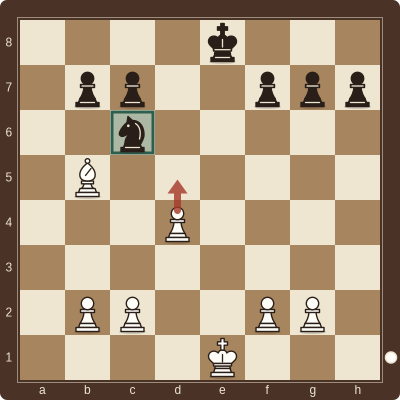
4k3/1pp2ppp/2n5/1B6/3P4/8/1PP2PP1/4K3 w - - 0 1Taking at once with Bxc6+ only swaps a bishop for a knight, since bxc6 recaptures. The quiet push d5 is much stronger. The knight is attacked by a pawn and has no legal move, so a reply such as h6 is met by dxc6.
Black can bring the king to guard it with Kd7. Even then White comes out ahead: after dxc6+ and bxc6, pull the bishop back with Ba4 and keep it. You have won a knight for a pawn.
Notice the order of thought. Ask first whether the pinned piece is defended and by what. Then ask what each side can add. When the pinner is no weaker than the pinned piece, one attacker against one defender wins nothing yet. The extra attacker is what turns pressure into material.
- Look first for a pawn that can reach the pinned piece.
- Count attackers and defenders before you start capturing.
- Do not hurry to exchange the pinner while the target cannot move.
How to break a pin
You have four main tools: chase the pinner, put a piece in between, move the piece behind, or add enough defenders to make the capture harmless.
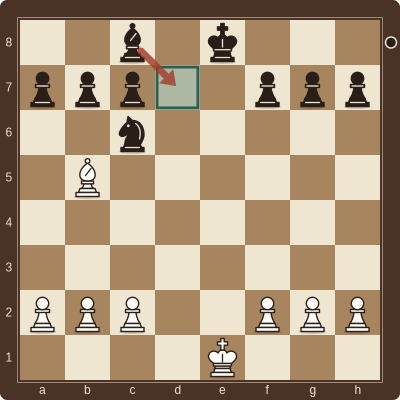
2b1k3/ppp2ppp/2n5/1B6/8/8/PPP2PPP/4K3 b - - 0 1After Bd7 the line from b5 to the king is blocked twice, and the knight is free to move again. If White exchanges on c6, the bishop on d7 can recapture.
Moving the piece behind is the simplest cure when it is not the king. Step the queen off the diagonal and the front piece is free at once. With an absolute pin the king itself can walk away, though that may take away the right to castle.
For a pin against the queen, pawns can do the chasing. Go back to the relative pin position. The moves h6, Bh4, g5 and Bg3 push the bishop off the diagonal. It works, but the pawns in front of your king have advanced and cannot go back. Make sure your king can live with that.
Common pin mistakes
- Capturing the pinned piece immediately when a pawn attack would win more.
- Treating a relative pin as absolute and forgetting the opponent may move the front piece with a threat.
- Counting a pinned piece as a defender when it cannot legally recapture.
- Chasing a pinner with so many pawns that your own king is left exposed.
- Pinning with a piece that can simply be taken.
Check a pin on your own board
- Name the attacker, the front piece and the target behind it.
- Decide whether the target is the king.
- List what can attack the front piece next move.
- List the ways out for the defender.
Save any pin you miss with the Board builder, and write in the note which of the three pieces you overlooked. When the stronger piece stands in front instead, the motif is a skewer. A pinned defender also makes overload ideas much easier, and an absolutely pinned piece cannot punish a fork on a square that lies off its pin line.
Common questions
Can a pinned piece give check?
Yes. A piece that is pinned to its own king still attacks squares, so it can give check and it stops the enemy king from stepping there.
Can a pinned piece capture anything?
A pinned queen may capture along the pin line, including the pinning piece, and so may a rook or bishop that moves on that line. A knight pinned to its king cannot capture at all.
Is a relative pin ever safe to ignore?
Yes, when moving the front piece gives check, creates a bigger threat or wins more than you lose behind it. Calculate that before you move.
Can a knight pin another piece?
No. A pin needs an attacker that works along a rank, file or diagonal, which means a queen, rook or bishop.
Sources
- FIDE Laws of Chess taking effect from 1 January 2023. International Chess Federation (FIDE) Handbook. Rules of movement (Article 3), end of the game (Article 5), recording moves (Article 8), drawn positions (Article 9) and algebraic notation (Appendix C). Consulted on 25 November 2026.