Two very quick mates catch beginners again and again. Both go through a square next to a king that has not moved yet, and both can be stopped once you know what to look at.
You will replay each one move by move, defend against the scholar's mate with a clear plan, and know what to do after the attack fails.
Why f2 and f7 are weak
At the start of a game, the f7 pawn is protected by nothing but the black king. The f2 pawn is in the same state on White's side. The pawns beside them are covered by other pieces. A king is a poor guard: it cannot take back a piece that is protected. So an attacker who brings two pieces against f7 or f2 may break through at once.
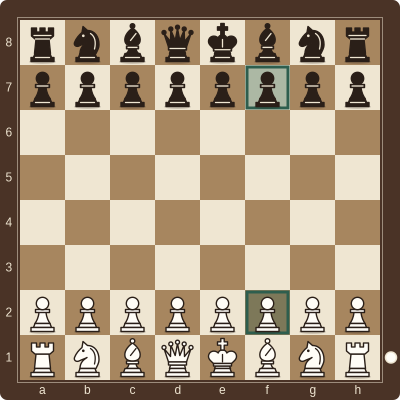
rnbqkbnr/pppppppp/8/8/8/8/PPPPPPPP/RNBQKBNR w KQkq - 0 1You do not need long opening knowledge to stay safe. In the first few moves, ask which enemy pieces point at your f-pawn, and whether the squares around your king are still closed.
Fool's mate: two moves
Fool's mate happens when White loosens the pawns in front of the king. The shortest version runs 1.f3 e5 2.g4 Qh4#.
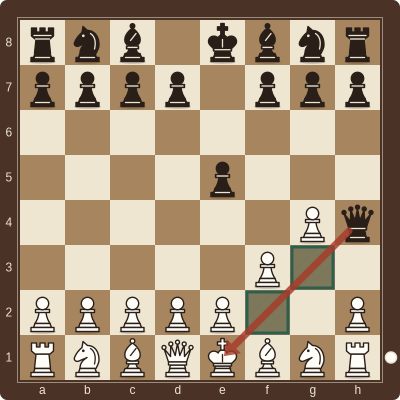
rnb1kbnr/pppp1ppp/8/4p3/6Pq/5P2/PPPPP2P/RNBQKBNR w KQkq - 1 3The line h4, g3, f2, e1 is open: the f-pawn has left f2, and the g-pawn, now on g4, can no longer go to g3. No white piece can capture the queen or step in between, and the king has no free square. No game can end in mate sooner than this.
The order of White's moves can change: 1.g4 e5 2.f3 Qh4# gives the same picture. Black's e-pawn may also go to e6, as in 1.f3 e6 2.g4 Qh4#. White can mate Black the same way, but needs a third move: 1.e4 g5 2.Nc3 f6 3.Qh5#.
The lesson is simple. Moving the f-pawn and g-pawn early opens a diagonal to your own king. Before you push either of them, look along that line for an enemy queen or bishop that could use it.
Scholar's mate: four moves
Scholar's mate points the queen and a bishop at the f7 square. A typical run is 1.e4 e5 2.Bc4 Nc6 3.Qh5 Nf6 4.Qxf7#.
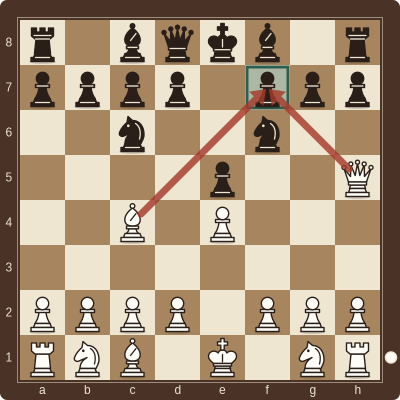
r1bqkb1r/pppp1ppp/2n2n2/4p2Q/2B1P3/8/PPPP1PPP/RNB1K1NR w KQkq - 4 4The queen captures on f7, touching the king. Taking her is not allowed, since the bishop on c4 guards that square. The move 3...Nf6 looks like a good way to chase the queen, but it does nothing for the square under fire.
The moves can arrive in another order, for example 2.Qh5 first and the bishop afterward. What matters is the picture: two attackers on f7 and one defender, your king.
How to defend against scholar's mate
Stop at the moment White's queen and bishop both point at f7. Your answer must protect that square or block one of the attackers. After 1.e4 e5 2.Bc4 Nc6 3.Qh5 you have good choices.
| Black plays | Why it works | What to watch |
|---|---|---|
| 3...g6 | Blocks the queen's line to f7 and attacks the queen | White may retreat to f3 and aim again |
| 3...Qe7 | Adds a second defender of f7 and guards e5 | The queen sits in front of your bishop |
| 3...Qf6 | Defends f7 and keeps an eye on f2 ideas | Your knight can no longer use f6 |
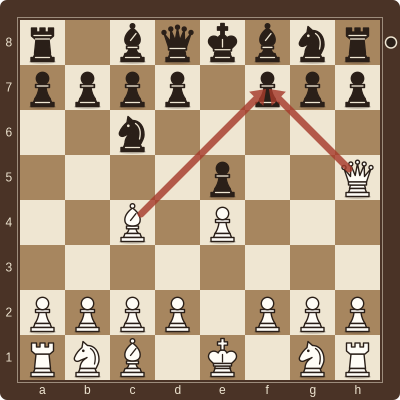
r1bqkbnr/pppp1ppp/2n5/4p2Q/2B1P3/8/PPPP1PPP/RNB1K1NR b KQkq - 3 3A natural reply is 3...g6. If White continues 4.Qf3, threatening mate on f7 again, answer 4...Nf6. The knight stands in the queen's way and develops at the same time. If White grabs f7 after 3...Qe7 or 3...Qf6, your queen takes back and nothing is mate.
After the same first two moves, the queen may also aim from f3, with 3.Qf3. There 3...Nf6 is a good answer, because the knight stands in the file between the queen and f7. The same knight move is a blunder against a queen on h5 and a good defense against a queen on f3. Before you move, check which line your piece is closing.
Common mistakes
Another serious slip is playing the pawn to g6 before e5 is protected. Compare this order.
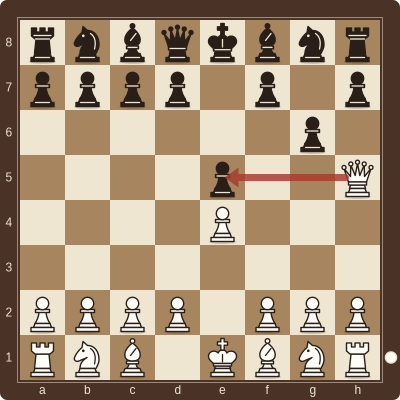
rnbqkbnr/pppp1p1p/6p1/4p2Q/4P3/8/PPPP1PPP/RNB1KBNR w KQkq - 0 3Black needed to protect e5 first, with Nc6. This is a plain fork: one queen move hits the king and the rook together.
- Chasing the queen with the knight while f7 is still under attack.
- Pushing g6 with e5 loose, which allows the fork shown above.
- Bringing your own queen out too far in reply, where it becomes a target.
- Relaxing after one threat. The attacker may line up on f7 again.
In the safe order, 2.Qh5 is met by 2...Nc6, and only after 3.Bc4 does the pawn go to g6. If White then plays 4.Qf3, the knight comes to f6.
After the attack fails
A queen that comes out early often has to move again. Use that. Develop a knight or bishop each time you have a chance, preferably with a gain of time against the queen. After 3...g6 and 4...Nf6, your bishop can come to g7 and your king can castle.
Castling matters here. Once your king stands on g8, the rook arrives on f8, and f7 has two defenders where it had one. Until then, count the attackers on that square after every White move.
When an early queen appears
Check these before choosing a move.
- Which of my squares do the queen and bishop point at together?
- Is e5 protected before I push a pawn to g6?
- Can a developing move block or defend at the same time?
- After the threat is gone, which piece can I bring out next?
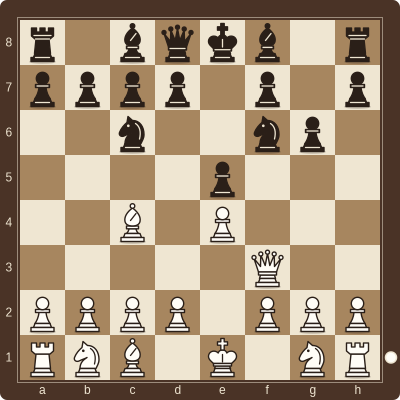
r1bqkb1r/pppp1p1p/2n2np1/4p3/2B1P3/5Q2/PPPP1PPP/RNB1K1NR w KQkq - 2 5To write these games down and replay them, see algebraic notation. To be sure a final position is mate, use the checkmate test. When a single defender holds your opponent's position together, removing the defender is the next idea to learn.
Set up the position after 3.Qh5 in the Board builder, save it with a note listing your three defenses, and revisit it before your next game.
Common questions
What is the fastest checkmate in chess?
Fool's mate. Black can give it on the second move if White opens the diagonal to the king with the f-pawn and g-pawn.
What is the best defense against scholar's mate?
A common choice is g6 after your knight protects e5. Qe7 and Qf6 also guard f7.
Can White be mated by scholar's mate too?
Yes. The same idea against f2, with a black queen and bishop, threatens a white king that has not moved.
Is scholar's mate a good opening?
It works only if the defender misses the threat. A careful reply stops the mate, and the early queen often has to move again, which gives you time to bring out your pieces.
Sources
- FIDE Laws of Chess taking effect from 1 January 2023. International Chess Federation (FIDE) Handbook. Rules of movement (Article 3), end of the game (Article 5), recording moves (Article 8), drawn positions (Article 9) and algebraic notation (Appendix C). Consulted on 25 November 2026.