A fork is one piece attacking two enemy pieces at the same moment. Your opponent gets a single move to answer. If that move cannot rescue both targets, one of them is yours.
Work through the five positions below and you will be able to spot forks by knights, pawns, queens and kings, test whether a fork really wins something, and see one coming against you while there is still time.
One move, two threats
The idea is simple. You move a piece to a square from which it hits two things. The strongest forks include the enemy king, because a check must be answered at once. The other target then often stays where it is for one move too long.
Any piece can fork, including a pawn and your own king. What changes is the shape of the attack. Learn the shape of each piece and you will start to notice pairs of targets that fit it.
| Forking piece | What it can hit together | Check before you play it |
|---|---|---|
| Knight | Two or more squares one knight jump away, all of one color | Can the forking square be captured? |
| Pawn | The two squares diagonally ahead of it | Is the pawn defended on its new square? |
| Queen | Targets on any ranks, files or diagonals from one square | Can one reply block and defend at once? |
| King | Two neighboring pieces | Is the king's new square safe? |
The knight fork and the color rule
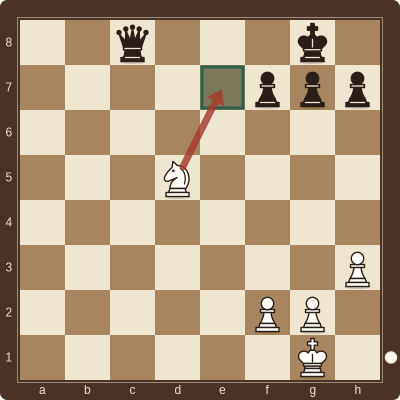
2q3k1/5ppp/8/3N4/8/7P/5PP1/6K1 w - - 0 1After Ne7+, Black must deal with the check. No black piece can capture the knight, and a knight check cannot be blocked. The king steps to f8 or h8, and Nxc8 follows either way. White started far behind in material and ends a knight ahead against pawns.
Now look at the colors. The targets on g8 and c8 both stand on light squares. A knight always attacks squares of the color opposite to the one it stands on, so from e7, a dark square, it can only hit light ones. If two enemy pieces stand on different colors, no knight can attack both of them at once.
That gives you a fast filter. Find two loose or important enemy pieces on the same color, then ask whether any square lies one knight jump from each, and whether your knight can reach it.
Pawn forks
A pawn is the smallest forker, which makes its forks painful. Almost any piece it traps in the pair is stronger than the pawn.
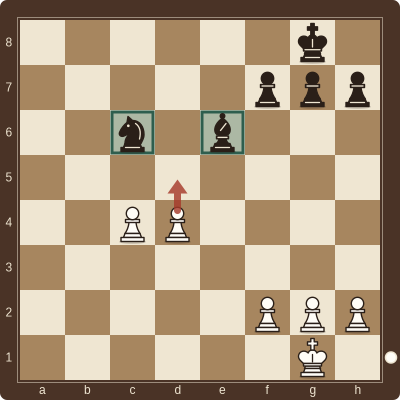
6k1/5ppp/2n1b3/8/2PP4/8/5PPP/6K1 w - - 0 1Before White moves, the knight is attacking the pawn on d4. Pushing it does two jobs: it escapes the knight and it forks. The c4 pawn guards the new square, so Bxd5 is met by cxd5, and the pawn that arrives attacks the knight again.
If the knight runs instead, for example to b4, then dxe6 takes the bishop. Whatever Black tries, White wins a piece and gives up no more than a pawn for it. The pawn guarding your forker is what makes this work, so check for it first.
Queen and king forks
The queen: long range, many shapes
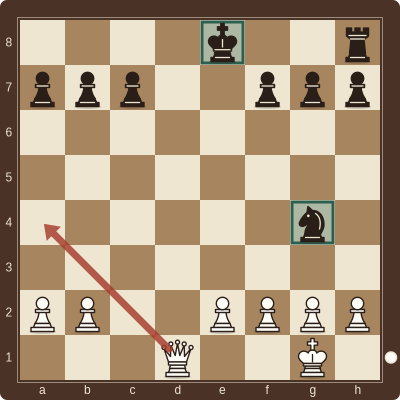
4k2r/ppp2ppp/8/8/6n1/8/PP2PPPP/3Q2K1 w - - 0 1The white queen cannot capture the knight from d1, because the e2 pawn is in the way. Qa4+ checks along the diagonal and attacks g4 along the rank. Black can block with c6 or b5, or move the king, but none of those replies protects the knight. Qxg4 wins it.
The move b5 deserves a second look, since that pawn attacks your queen. It does not matter here: the queen leaves a4 by taking the knight. Give extra care to replies that block and hit back at the same time.
The king: a fork that never gives check
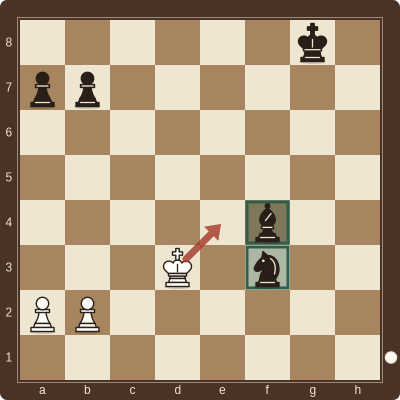
6k1/pp6/8/8/5b2/3K1n2/PP6/8 w - - 0 1Neither black piece guards the other, and neither attacks e4. After Ke4 Black cannot save both. Nd2+ looks active, yet Kxf4 still works. If the bishop leaves with Bh6, Kxf3 takes the knight. Endings with few pieces are where your king forks most often.
When a fork really works
Two attacked pieces do not always mean material. A fork fails when the forking piece can simply be taken, when one target leaves with a check, or when one target moves and defends the other.
It also fails if both targets are well defended and no stronger than your forker. A queen that attacks two protected knights threatens nothing, because capturing either one gives up the queen.
Five questions before you fork
- Can the enemy capture on the forking square? If so, what do you get back?
- Can either target move away while giving check?
- Can one target move and still guard the other?
- Which of the two will you take, and is that capture safe?
- Can your piece leave the corner or edge afterward?
To practice, set up a position on the Board builder, play the fork by dragging the piece, then try every reply by hand. The builder does not judge moves, so the testing is yours.
Defending against a fork
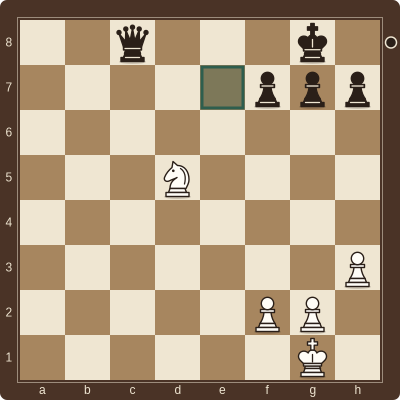
2q3k1/5ppp/8/3N4/8/7P/5PP1/6K1 b - - 0 1Black has two kinds of defense here. Guard the forking square: after Kf8 or Qd8, the jump Ne7 just loses the knight. Or take one target out of the pattern: Kh8 puts the king on a dark square, so the knight on e7 can only chase the queen, which steps aside.
The habit to build is short. After each enemy move, look at every square their knight can reach next. Do the same for pawn pushes that would touch two of your pieces. Two loose pieces are an invitation.
If the fork has already happened, look for a check of your own. A target that escapes with check can win you the time to save the second piece. Failing that, give up the weaker of the two and keep the stronger.
Common fork mistakes
- Forking on a square the enemy guards without counting the captures.
- Seeing the two targets and forgetting the enemy's checks.
- Grabbing the first target in reach when the other one is stronger.
- Searching for knight forks on pieces that stand on different colors.
- Leaving your forking piece where it will be trapped after the capture.
A fork often works together with other motifs. A pin can stop a defender from capturing your knight. A skewer also hits two pieces, but along one line, and a discovered attack can create two threats using two of your pieces. A knight check against a boxed-in king can even be smothered mate.
Common questions
Can a king fork two pieces?
Yes. A king can move next to two enemy pieces at once, as long as the new square is not attacked. It happens mostly in endings.
What is the difference between a fork and a double attack?
A double attack means two threats made at once, possibly by different pieces. A fork is the case where a single piece makes both.
Can a knight fork pieces on different square colors?
No. From any square a knight attacks squares of one color only, so both targets must share that color.
How do I get better at seeing forks?
Look for loose pieces and exposed kings first. Then check which single square would attack two of them, and whether you can reach it safely.
Sources
- FIDE Laws of Chess taking effect from 1 January 2023. International Chess Federation (FIDE) Handbook. Rules of movement (Article 3), end of the game (Article 5), recording moves (Article 8), drawn positions (Article 9) and algebraic notation (Appendix C). Consulted on 25 November 2026.