Each bishop lives on one square color for the whole game. Your own pawns can stand in its way, and when they do, the piece has much less to do.
By the end you should be able to name the good and the bad bishop on both sides from the pawns alone, and decide which one deserves to be swapped.
What makes a bishop bad
A bishop is called bad when many of its own pawns, above all the central ones that cannot easily move, stand on the squares it travels on. The bishop whose pawns sit on the other color is called good. The labels describe the pawns around the piece, not how well it was built.
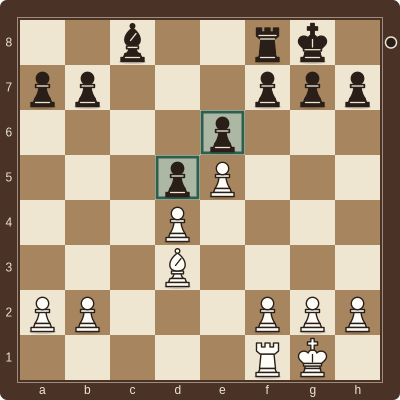
2b2rk1/pp3ppp/4p3/3pP3/3P4/3B4/PP3PPP/5RK1 b - - 0 1Black's center pawns on d5 and e6 are on light squares, the same color the c8 bishop uses. It can step to d7 and nowhere else. White's pawns on d4 and e5 are on dark squares, so the white bishop on d3 moves freely along both of its diagonals. Same piece type, very different lives.
A restricted bishop usually brings two problems. It has few squares to go to, and it can never help on the other color. Here Black's center pawns also attack only light squares, so the dark ones are easier for White's pieces to occupy.
Read the pawn colors in three steps
- Find the pawns of one side that stand in the center and are blocked by an enemy pawn.
- Note the color of the squares they stand on.
- Compare it with each bishop. A matching color suggests a restricted bishop, the opposite color a free one.
Pawns can change this picture. A pawn that advances one square moves to the other color, while a double step or a diagonal capture keeps the same color. So a single pawn push can turn a poor bishop into a useful one, and the other way round.
Count every pawn, but give the blocked central ones the most weight. An edge pawn that can still move changes much less than a pair of pawns fixed in the middle of the board.
A bad bishop can still be busy
Bad is a description, not a sentence. A bishop that has got out in front of its own pawns may be very strong, even though they stand on its color.
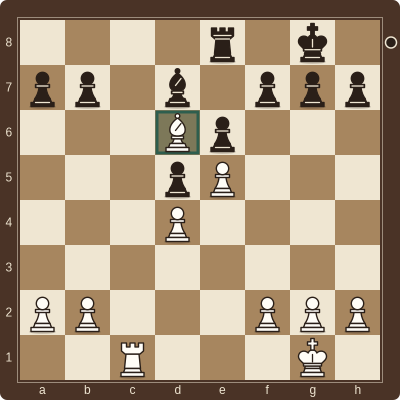
4r1k1/pp1b1ppp/3Bp3/3pP3/3P4/8/PP3PPP/2R3K1 b - - 0 1On paper the d6 bishop is White's bad one, because d4 and e5 share its color. In practice it stands deep in Black's half, protected by the e5 pawn, and it covers c7, e7, b8 and f8. Do not swap a piece like this just because a rule of thumb calls it bad.
Trade your bad bishop
If your bishop is stuck behind its pawns and the opponent's good bishop can meet it, offer the exchange. You lose your worst piece and they lose one of their best. Make sure the square where you offer it is protected.
Bishops can only capture each other when they share a color. If theirs lives on the opposite color to yours, you need a different piece or a pawn to remove it, or you have to leave it alone.
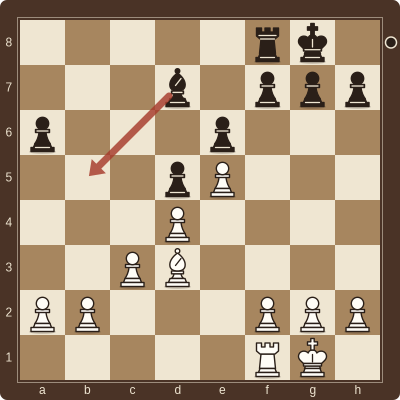
5rk1/3b1ppp/p3p3/3pP3/3P4/2PB4/PP3PPP/5RK1 b - - 0 1After Bb5 Bxb5 axb5 Black no longer has a piece shut in behind the pawns, and White no longer has the bishop that was eyeing the king side. White could refuse by retreating. The offer still has a use: it asks White to choose.
Another route is to move a pawn so that your bishop gets a way out, or to route the bishop outside the chain before the pawns close behind it.
Leave their bad bishop on
The mirror image matters just as much. If your opponent has a restricted bishop and your own is the good one, exchanging them does the opponent a favor.
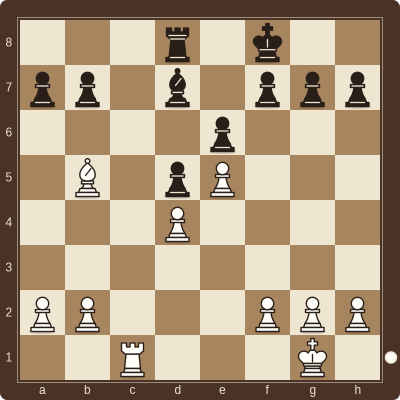
3r1k2/pp1b1ppp/4p3/1B1pP3/3P4/8/PP3PPP/2R3K1 w - - 0 1After Bxd7 Rxd7 the count is unchanged, but Black's cramped bishop has vanished, which solves Black's main problem. With Bd3 the white bishop moves to the diagonal that points at h7, while the black one still sits behind its own pawns.
The exception is a bad bishop that is the only defender of something important. Removing it can then win the pawn or square it was guarding, so calculate that sequence move by move before you decide.
While their bishop stays on, aim your pieces at squares of the other color, where it cannot answer. Those are the squares on which your king or a knight can settle.
Common mistakes with bishop swaps
- Judging the starting square. Color of the pawns now matters, not where the bishop began.
- Adding more pawns on your own bishop's color. Each one narrows its path.
- Swapping their bad bishop out of habit. Removing it often solves their problem for them.
- Calling an active piece bad and giving it up. Look at what it attacks first.
- Forgetting that pawns can still move. Recheck the colors after each pawn change.
Before you swap a bishop
| Your bishop | Their bishop | Usual idea |
|---|---|---|
| Restricted and passive | Good | Offer the swap |
| Good | Restricted | Keep both, trade other pieces |
| Restricted but active | Any | Keep it while it stays active |
| Good | Good | Decide on other grounds |
Bishop check
- Which color do my blocked pawns stand on?
- Is my bishop inside or outside the chain?
- Which color do their blocked pawns stand on?
- Who is happier once these two bishops are gone?
These ideas are guidelines, so weigh them against tactics and king safety, using the wider questions on when to trade pieces. If the choice is between a bishop and a knight, that is a separate topic: see bishop or knight. Both count the same in the point count. With two bishops working together, color stops being a limit, as the two bishops checkmate shows.
Set up one of your own games in the Board builder, flip the board to see it from the other side, and save it with a note saying which bishop you would keep.
Common questions
What is a bad bishop in chess?
A bishop whose own pawns, especially the fixed central ones, stand on the color it moves on, so its diagonals are crowded.
Is a bad bishop always weak?
No. One that stands outside its pawn chain can be very active. Judge what it attacks, not just the color of the pawns.
Can a bishop change color?
No. A bishop moves only diagonally, so it stays on the color it started on for the whole game.
How do I get rid of a bad bishop?
Offer an exchange on a protected square, or advance a pawn by one square so that it moves to the other color and may open a diagonal.
Sources
- FIDE Laws of Chess taking effect from 1 January 2023. International Chess Federation (FIDE) Handbook. Rules of movement (Article 3), end of the game (Article 5), recording moves (Article 8), drawn positions (Article 9) and algebraic notation (Appendix C). Consulted on 25 November 2026.