A swap is not good or bad because two pieces leave the board. It is good or bad because of what they leave behind. This page gives you five questions to run before you capture, with a board for most of them.
Use them when you are offered an exchange and when you can offer one yourself. They are guidelines, not laws. A concrete tactic beats every one of them, so look at checks, captures and threats first.
Look at what stays on the board
Before you think about the two pieces that would leave, picture the position without them. Which of your remaining pieces suddenly has a clear road? Which of your opponent's pieces loses its partner or its guard? A swap can turn a quiet rook into the strongest piece on the board, or remove the only defender of a weak square.
A simple trick is to cover both pieces with your fingers and read the position again. Then ask which side you would rather play. If you cannot tell, the swap is probably not urgent, and improving another piece may be the better move.
The point count comes before any of this: the page on piece points shows how to add up a chain of captures. The questions below matter most when the sum is level, such as queen for queen or knight for bishop.
Does the swap make a king safer?
A queen swap often removes the biggest threat to a loose king. If yours is the exposed one, trading attackers usually helps you. If you are attacking, think twice before giving up the pieces that point at the enemy king.
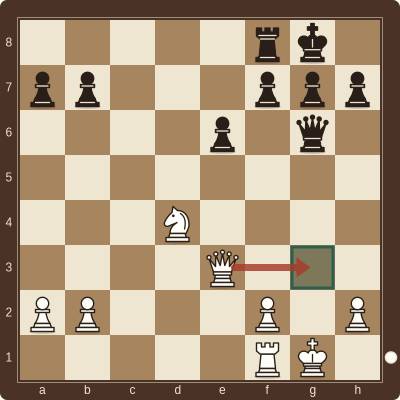
5rk1/pp3ppp/4p1q1/8/3N4/4Q3/PP3P1P/5RK1 w - - 0 1White has an extra knight and Black has two extra pawns. The black queen is aimed at a king that has lost its g-pawn. After Qg3 the white queen is protected by two pawns. If Black plays Qxg3+, White takes back, the attacker is gone, and the extra knight can work without watching for queen checks.
Two recaptures are legal. With hxg3 the f-pawn stays at home in front of the rook. With fxg3 the f-file becomes half-open for the rook on f1. Choose by asking which line helps your pieces, not by which capture comes to mind first.
Who needs more room?
The side with less space often gains from swaps, because fewer pieces have to share the same few squares. The side with more space tends to prefer keeping them on, so that the cramped army stays tangled. A safe but cramped setup can still be happy to wait.
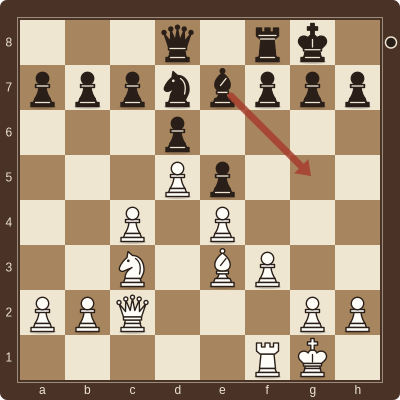
3q1rk1/pppnbppp/3p4/3Pp3/2P1P3/2N1BP2/PPQ3PP/5RK1 b - - 0 1White's center pawns reach further, so Black's pieces live in a smaller area. Bg5 asks to remove one pair of bishops. After Bxg5 Qxg5 each side has one piece fewer, the black queen has left the back rank, and the squares behind Black's pawns are less crowded. White may also say no by moving the attacked bishop away.
Watch which piece you trade, not only how many. A cramped side usually wants to remove the piece that has nowhere to go, or the attacker that keeps it tied down.
What happens to the pawns after the recapture?
A capture usually invites a recapture, and the recapture can reshape the pawns. Look for two pawns stacked on one file, pawns with no neighbor to support them, and files that open for a rook. Then ask who is happier with the new shape.
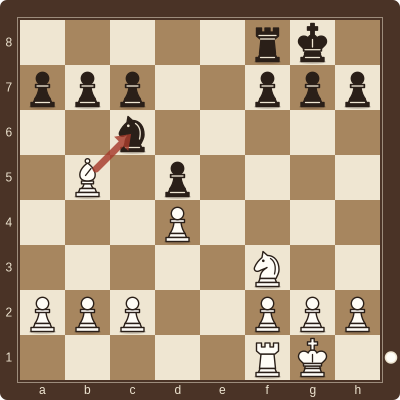
5rk1/ppp2ppp/2n5/1B1p4/3P4/5N2/PPP2PPP/5RK1 w - - 0 1After bxc6 Black has two pawns on the c-file and no b-pawn. From where they stand, none of Black's pawns guards c5. White's knight can head for e5 with Ne5, where it attacks the front c-pawn. Black does get the half-open b-file for a rook, so weigh both sides of the change.
Is your piece busier than theirs?
A piece is only as strong as what it is doing now. Swapping your busy piece for a sleepy one helps your opponent. Capturing whatever is offered, out of habit, is a common way to let a good position drift back to level.
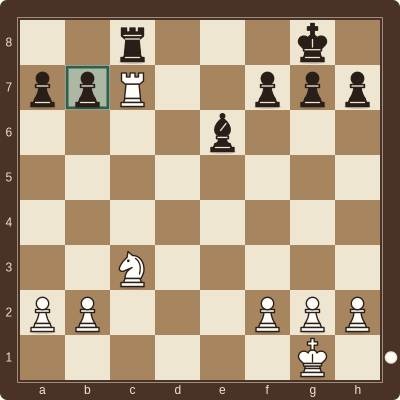
2r3k1/ppR2ppp/4b3/8/8/2N5/PP3PPP/6K1 w - - 0 1The white rook on c7 stands among Black's pawns. The black rook is still on its own back rank. After Rxc8+ Bxc8 White's best placed piece has traded itself away and nothing has been gained. Rxb7 keeps it active and wins a pawn, since no black piece or pawn defends b7.
Common mistakes when swapping
- Capturing because you can. An offered exchange is a question, not an order.
- Giving up your attacker. If your pieces aim at the enemy king, removing one of them often helps the defender.
- Skipping the recapture. Work out what takes back, and which files and squares change when it does.
- Watching only the two pieces. The ones that remain decide who is happier afterward.
- Swapping everything once ahead. A lead helps only if the final position can still be won. See how to simplify when you are ahead.
The five questions on one card
| Question | Leans to swapping | Leans to keeping |
|---|---|---|
| Whose king is under pressure? | Yours | Theirs |
| Who has less room? | You | Your opponent |
| What does the recapture do to the pawns? | Weakens theirs | Weakens yours |
| Which of the two pieces is busier? | Theirs | Yours |
| Who likes what stays on the board? | You | Your opponent |
Before you capture
- I looked for checks, captures and threats by both sides.
- I pictured the board without the two pieces.
- I know which piece or pawn takes back.
- I can name one thing the swap improves for me.
- If these are the last pieces, I have calculated the pawn ending.
The final box has its own page, because trading into a pawn ending cannot be reversed and a single square can change the result. For the most common minor piece choice, read bishop or knight.
To study an exchange calmly, set up the position in the Board builder, save it with a note, and play both choices on a real board before you decide which one you like.
Common questions
Should I trade queens early?
Only if the swap helps you. It tends to suit the side whose king is weaker, and it hurts the side whose attack depends on the queen.
Is it good to swap pieces when I have less space?
Often, as a guideline. Each pair that leaves gives the rest more squares, but check that you are not giving up your best defender.
Do I have to recapture after a swap?
No rule forces you, unless the recapture is your only legal move. Skipping it usually leaves you behind in points, so look carefully first.
What should I check first before a trade?
Checks, captures and threats for both sides. The strategic questions only matter once you know the exchange does not lose something.
Sources
- FIDE Laws of Chess taking effect from 1 January 2023. International Chess Federation (FIDE) Handbook. Rules of movement (Article 3), end of the game (Article 5), recording moves (Article 8), drawn positions (Article 9) and algebraic notation (Appendix C). Consulted on 25 November 2026.