A bishop and a knight both count three points, so the count cannot choose for you. The pawns usually can. After this page you can look at a structure and say which of the two is likely to be happier.
Use it before an exchange, or while planning where your pieces should go. These are guidelines. A tactic or one very strong square can overrule any of them.
Open positions and two wings
A bishop moves any distance along a clear diagonal. When files and diagonals are open, it can act on both sides of the board at once. A knight moves in short jumps and needs time to cross from one wing to the other.
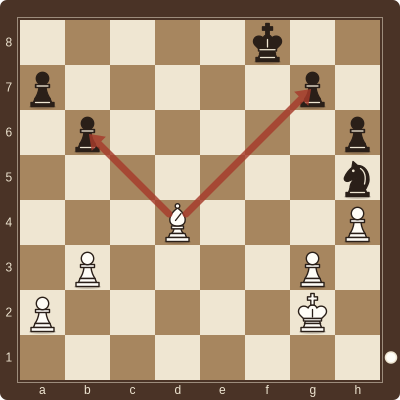
5k2/p5p1/1p5p/7n/3B3P/1P4P1/P5K1/8 w - - 0 1From d4 the bishop touches a target on each wing without moving. A knight shifts at most two files per jump, so the one on h5 needs at least three moves to reach the b-file. While it travels, it can do little on the side it left.
Passed pawns on opposite wings make this sharper still, because a single bishop may be able to watch both. When all the pawns are on one wing, the handicap mostly disappears.
Range also helps in defense. If one of its diagonals crosses the path of an enemy passed pawn, a bishop can hold that pawn back from the far side of the board. It can only do so on its own color, so check that the diagonal really covers a square the pawn must cross.
Closed positions and locked pawns
When pawns face each other head to head, they turn into walls. A bishop may find its diagonals blocked, or its targets out of reach. A knight simply jumps over the walls and can arrive from an odd angle.
Look at where the enemy pawns are fixed. A pawn that cannot move is a lasting target, and a knight can in time attack targets on both square colors. A bishop can only ever attack the ones that stand on its own.
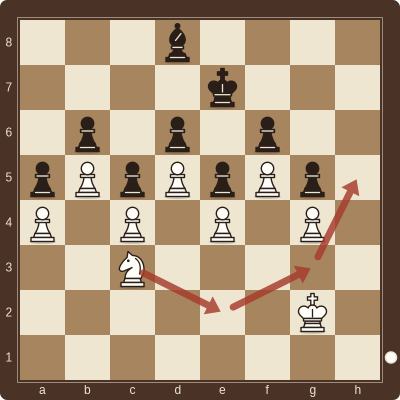
3b4/4k3/1p1p1p2/pPpPpPp1/P1P1P1P1/2N5/6K1/8 w - - 0 1One possible sequence is Ne2 Bc7 Ng3 Bb8 Nh5. From h5 the knight attacks the pawn on f6, which Black must now keep defended. The black bishop can shuffle behind its own pawns, but it cannot get past them while the chain holds, and it cannot touch a single white pawn.
This is an extreme case. A closed position often opens with one pawn break, so before you give up a bishop for a knight, look for the pawn move that would clear its lines later.
Outposts: a home for the knight
An outpost is a square, usually in or near the enemy half, where no enemy pawn can chase your piece away, ideally one that your own pawn protects. A knight on such a square can dominate for many moves, because its short range is no problem when it already stands near the targets.
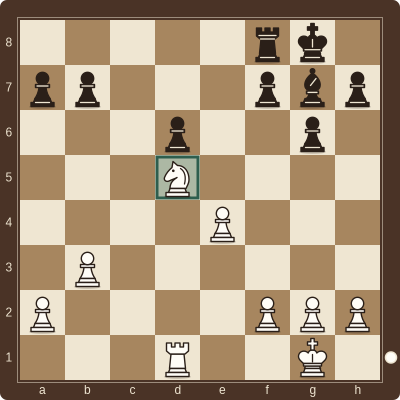
5rk1/pp3pbp/3p2p1/3N4/4P3/1P6/P4PPP/3R2K1 w - - 0 1Black's c-pawn and e-pawn are gone, so no pawn can step up to attack d5. The black bishop runs on dark squares and d5 is light, so it can never touch the knight. From there it covers b6, c7, e7 and f6. This is a clear case for keeping the knight.
Compare the colors: a bishop only becomes a good answer to a knight outpost if it travels on that square's color. The page on good and bad bishops looks at color in more detail.
Outposts are often made rather than found. Once an enemy pawn has advanced past a square, or has been exchanged away, it can no longer guard it. Before you trade pawns, ask which squares will lose their last pawn protector, and which of your pieces could use them.
The bishop pair
Keeping both bishops while your opponent has only one, or none, is called having the bishop pair. One covers light squares and the other dark ones, so together they can reach any square. In open positions this is often a lasting plus.
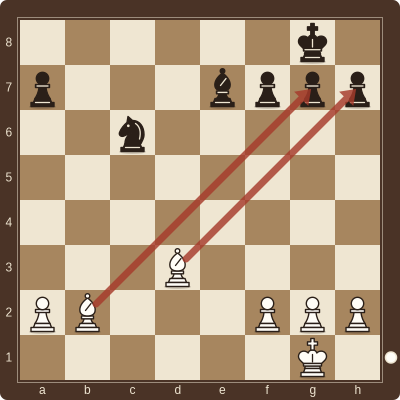
6k1/p3bppp/2n5/8/8/3B4/PB3PPP/6K1 w - - 0 1Before you trade one of them, ask what you get back. Giving up the pair to damage the enemy pawns or to win a key square can be a fine choice. Giving it up for nothing visible usually is not.
To use the pair, open lines. Exchanging a center pawn or two gives both pieces more room. If the opponent can keep the position shut, the pair may count for little and a knight can be the better partner.
A decision table
| What you see | Usually favors | Reason |
|---|---|---|
| Open files and diagonals | Bishop | Long lines to use |
| Locked pawn chains | Knight | Jumps over the walls |
| Pawns on both wings | Bishop | Reaches both sides quickly |
| Pawns on one wing only | Either | Short range matters less |
| A square no pawn can attack | Knight | A lasting outpost |
| You still have both bishops | Keep the pair | Covers both colors |
Applying it to the outpost board
Take the position with the knight on d5 and run the table.
- The board is half open, so neither side gets a clear edge from that.
- There are pawns on both wings, a small point for the bishop.
- The protected square is a large point for the knight, and it decides.
When two rows pull in opposite directions, give the most weight to the feature that will last. A square that no pawn can ever challenge stays that way, while a pawn capture can close an open file again.
Common mistakes when choosing
- Deciding by habit. Favoring one piece in every position ignores the pawns in front of you.
- Dropping the bishop pair for nothing. Ask what the exchange gains.
- Leaving a knight on the edge. From h5 it can reach only four squares.
- Calling a square an outpost too soon. Check that no enemy pawn can still attack it.
- Ignoring where the pieces stand today. A misplaced favorite may be the weaker piece.
Both pieces can create threats in their own way. Knights are well known for hitting two targets at once, covered in the chess fork. For the number side, see piece points, and for the wider decision, when to trade pieces.
To practice, build positions from your games in the Board builder, tag them with the structure you see, and decide which minor piece you would keep before you look at your note.
Common questions
Is a bishop better than a knight?
Neither always. A bishop tends to be stronger in open positions with pawns on both wings, a knight in closed positions and on outposts.
What is the bishop pair?
It means you still have both bishops, one on each color, while your opponent does not. It is often useful when the position is open.
When is a knight better than a bishop?
Usually when pawns are locked, when the play is on one side of the board, or when the knight has a square no enemy pawn can attack.
What is an outpost in chess?
A square, usually in or near the enemy half, that your piece can use without being chased by an enemy pawn.
Sources
- FIDE Laws of Chess taking effect from 1 January 2023. International Chess Federation (FIDE) Handbook. Rules of movement (Article 3), end of the game (Article 5), recording moves (Article 8), drawn positions (Article 9) and algebraic notation (Appendix C). Consulted on 25 November 2026.