A skewer is an attack along a line on two enemy pieces, one behind the other, with the more important one in front. It usually has to get out of the way, and then what it was covering can fall.
After the four positions below you should be able to find rook, bishop and queen skewers, tell them apart from pins and keep your own pieces off dangerous lines.
The shape of a skewer
Picture a straight line with your attacker at one end. Next comes a king or a strong piece, and further along a second target. You do not attack the second target yet. You attack the first and let it move.
Only a queen, rook or bishop can skewer, because only they act along a line. The squares between the attacker and the front piece must be empty, and so must the squares between the two targets.
The strongest version is a check. The king has to respond at once, so there is often no time to rescue what stands behind it.
To find skewers, start from the enemy king and queen instead of from your own pieces. Draw the eight lines that leave each of them. Wherever another enemy piece sits further along the same line, ask whether you can arrive on the opposite end. Open positions with few pawns offer far more of these lines than crowded ones.
Rook skewers with check
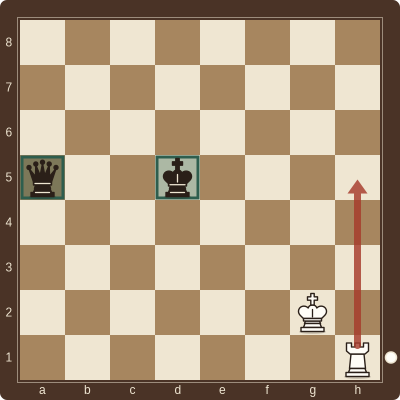
8/8/8/q2k4/8/8/6K1/7R w - - 0 1White has a rook against a queen and looks lost. One move turns it round. Rh5+ checks the king through g5, f5 and e5. The king must leave the fifth rank, because the queen cannot block or capture.
Wherever it goes, Rxa5 follows. The king ends too far from a5 to take the rook back, and White is left with king and rook against a lone king, which is a won ending. It is also the only winning move in the position.
Notice what made the skewer work. The two black pieces shared a rank, the rook could reach that rank from a square the queen did not cover, and the check left no time.
A bishop skewer without check
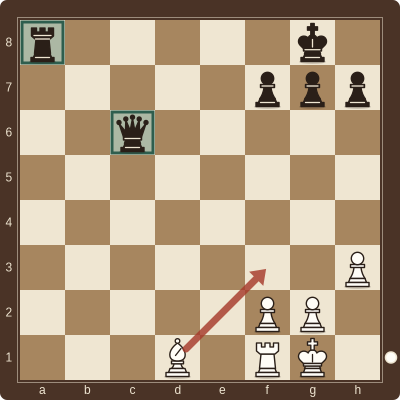
r5k1/5ppp/2q5/8/8/7P/5PP1/3B1RK1 w - - 0 1Here nothing is in check. Bf3 simply attacks the queen on its diagonal, and the g2 pawn guards the bishop. Taking it with Qxf3 gives up the queen after gxf3.
So the queen must move. If it steps to d7, Bxa8 collects the whole rook. Black's best idea is to keep the rook defended, for instance with Qc8. After Bxa8 and Qxa8, White has still traded a bishop for a rook, a clear gain.
A skewer without check gives the opponent a free choice of reply. Look at every square the front piece can go to, and ask whether any of them keeps the rear piece safe or attacks something of yours.
Bishops make good skewering pieces because a rook cannot hit back along a diagonal. The rook on a8 has no way to touch the attacker on that line, and a queen that captures a defended bishop is lost in return. Look for an enemy queen and rook that share a long diagonal.
Queen skewers on long lines
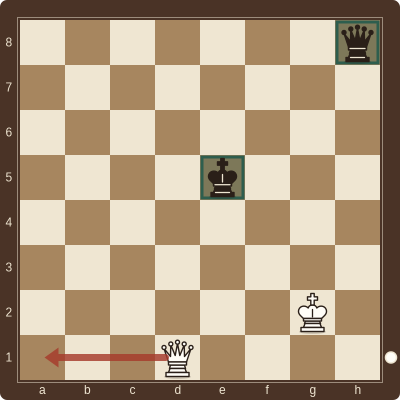
7q/8/8/4k3/8/8/6K1/3Q4 w - - 0 1The queens look equal, but the black king stands on the diagonal between a1 and h8. After Qa1+ the king has to leave it, and Qxh8 follows against any of its six moves.
The queen combines rook and bishop, so it often reaches a skewering square from an unexpected side. Here it moves along the first rank first and only then uses the diagonal. When you hunt for queen skewers, trace every line through the enemy king, not just the one you are already standing on.
Pin or skewer
| Point | Pin | Skewer |
|---|---|---|
| Piece in front | The less important one | The more important one |
| What the front piece feels | It cannot or should not move | It is attacked and must usually move |
| What you usually win | The front piece, with more attackers | The piece behind |
| Pieces that can do it | Queen, rook, bishop | Queen, rook, bishop |
| If the king is involved | It stands behind | It stands in front, in check |
A quick test: look at the order. If the more important of the two enemy pieces is the first thing your attacker meets, think skewer. If it is the second, you are looking at a pin.
Preventing a skewer
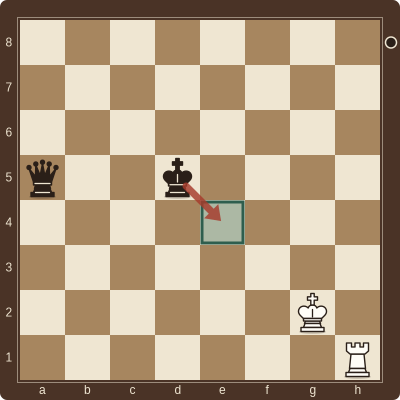
8/8/8/q2k4/8/8/6K1/7R b - - 0 1With one move in hand, Black plays Ke4. The same rook move, Rh5, now runs into Qxh5 and White is the side in trouble.
Prevention is mostly about timing. A king and queen on one line are harmless while no enemy rook, bishop or queen can reach that line safely. The danger starts when such a square appears, so check again after every exchange and every pawn move that opens a path.
- Notice when your king and queen share a rank, file or diagonal with open squares around them.
- Move one of them off the line before the enemy gets a turn.
- Keep a pawn or minor piece that can step into the line.
- In queen endings and after pawn races, check the long diagonals first.
Common skewer mistakes
- Giving a skewer check from a square the enemy can simply capture on.
- Forgetting that another enemy unit may be able to block the check.
- Missing a reply that moves the front piece and still protects the one behind.
- Confusing the order of the pieces and playing for a pin instead.
Before you give the skewer
- Is the path to the front piece clear?
- Is the path behind it clear once it moves?
- Can my attacking piece be taken?
- Can the rear piece be protected by the same move that answers me?
- After the capture, is my own king safe?
Set up each diagram with the Board builder and try every king move yourself. Skewers share their logic with the fork, which hits two things at once from one square, and with the discovered attack, which also relies on clear lines.
Common questions
Can a knight make a skewer?
No. A skewer needs a piece that attacks along a line. A knight jumps, so it cannot look through one target to another.
Can you block a skewer?
Sometimes. If there is an empty square between the attacker and the front piece and something of yours can reach it, you can interpose.
Does a skewer always involve the king?
No. Any strong piece in front can be skewered. A check is only the most forcing version, since a check must be answered immediately.
What is the difference between a skewer and a fork?
A skewer hits two targets standing one behind the other on a single line. A fork hits two targets in different directions from the same square.
Sources
- FIDE Laws of Chess taking effect from 1 January 2023. International Chess Federation (FIDE) Handbook. Rules of movement (Article 3), end of the game (Article 5), recording moves (Article 8), drawn positions (Article 9) and algebraic notation (Appendix C). Consulted on 25 November 2026.