A discovered attack happens when you move one piece out of the way and a second piece, standing behind it, suddenly attacks something. One move creates the possibility of two threats.
The positions below show how to set up the two pieces, which square to choose for the front one, what changes when the uncovered line hits a king and how to spot the danger before it fires.
Building a battery
Two of your pieces on one line, with a target further along, form a battery. The rear piece is a queen, rook or bishop, because it has to act through the line. The front piece can be almost anything: a knight, a bishop, a rook, a pawn or even your king.
While the front piece stays put, nothing happens. The moment it leaves the line, the rear piece wakes up. Your opponent must now think about two things at once: what the rear piece now attacks, and what the front piece did on the way out.
Batteries are easy to miss, because your own piece seems to block your own attack. Make a habit of looking through it. For each of your rooks, bishops and queens, follow every line past the first friendly piece and see what sits at the far end.
| Front piece move | Rear piece attacks | Opponent's problem |
|---|---|---|
| Gives check | A queen or rook | Must answer the check first |
| Attacks a queen | The king, giving check | Must use the turn on the check |
| Captures something | A second target | Cannot recapture and defend together |
| Moves with no threat | A king or piece | Faces only one problem and may cope |
Discovered check
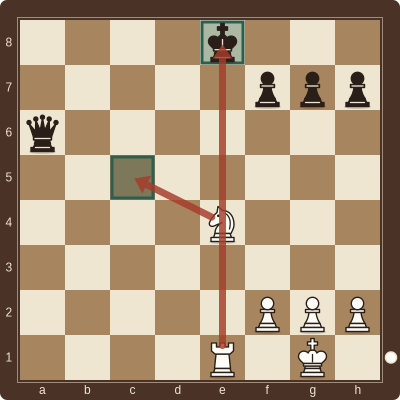
4k3/5ppp/q7/8/4N3/8/5PPP/4R1K1 w - - 0 1The check comes from the rook, not from the piece that moved. That is a discovered check. Black must deal with the e-file, and meanwhile the knight on c5 is looking at a6.
Count the replies. The king can step to d8 or f8, and then Nxa6 takes the queen. The queen can block on e6, which allows Nxe6, or on e2, which allows Rxe2+. Every road loses her.
Now compare Nc3+. It is also a discovered check, but from c3 the knight does not touch the queen, so Black can step aside with the king and keep her. The square of the front piece decides everything.
A discovered check is powerful for one reason. The front piece is free to choose any square off the line that it can reach, because the check is already taken care of by the rear piece. Think of it as a second move that comes with the first.
Move the front piece with a threat
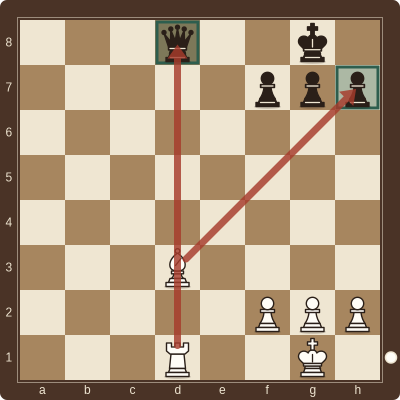
3q2k1/5ppp/8/8/8/3B4/5PPP/3R2K1 w - - 0 1This is the mirror image. Here the front piece gives the check and the rear piece wins material. After Bxh7+ Black has to move the king or capture the bishop. The queen on d8 gets no turn, so Rxd8 comes next.
The bishop is offered and it does not matter. Capturing it with Kxh7 gets back a bishop and loses a queen. When a front piece leaves with check, even a square that looks completely unsafe can work.
That is the practical lesson. Look at every square the front piece can reach, including ones where it can be taken. Whether it is guarded matters much less when capturing it leaves the other threat standing.
Then count the whole exchange, not just the first capture. If Black takes the bishop, White has given up a bishop and received a pawn and a queen. A discovery that wins a small piece while losing a larger one is not a tactic at all.
The windmill in brief
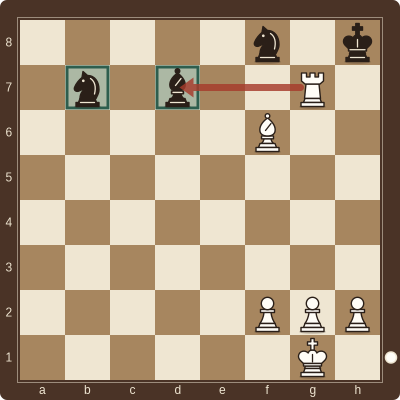
5n1k/1n1b2R1/5B2/8/8/8/5PPP/6K1 w - - 0 1A windmill repeats the discovery. Rxd7+ takes a bishop and uncovers the check from f6. The king is forced to g8. Rg7+ checks again and sends it back to h8, where the line is loaded once more. Then Rxb7+ takes a knight.
The sequence Rxd7+, Kg8, Rg7+, Kh8, Rxb7+ is the whole idea: one check to move the king, one discovery to collect. It needs a king with very few squares and a rear piece that cannot be blocked or captured. You will not meet it often, but it is a fine exercise in counting.
Defending against a discovery
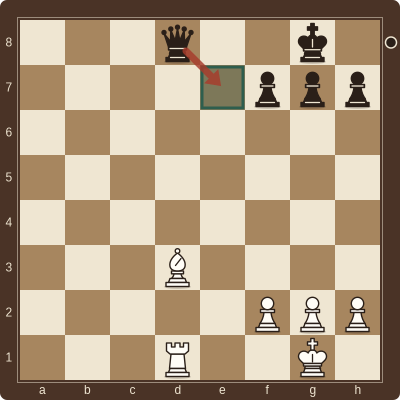
3q2k1/5ppp/8/8/8/3B4/5PPP/3R2K1 b - - 0 1Black to move plays Qe7. The rear rook no longer has a target, so Bxh7+ merely gives up the bishop after Kxh7.
- Move the target off the line before the front piece moves.
- Capture the front or rear piece while the battery is still loaded.
- Put something solid between the rear piece and its target.
- Give your king room, so that a discovered check is less restrictive.
The warning sign is easy to see: an enemy line piece looking at your king or queen, with exactly one enemy piece in the way. Treat that single piece as if it were already free to jump.
Then ask where it would go. List its squares one by one and look for the move that checks, captures or attacks something of yours. If one square does that, deal with the line now, while it is still your turn and the choice is yours.
Common discovery mistakes
- Moving the front piece to a quiet square when a threatening square was available.
- Forgetting that the opponent may block the rear piece and attack your front piece at once.
- Counting on the discovery while a pawn still stands further down the line.
- Leaving your own king exposed by the same move that opens the line.
Reading a battery
- Which two pieces of mine share a line with a target?
- Is the front piece the only thing in the way?
- Which squares let the front piece check or attack something?
- Does every enemy reply leave one threat standing?
If both the front and rear pieces check the king together, you have double check, which is stronger still. The battery is a close relative of the pin, with your own piece in the middle of the line, and the front piece often lands on a square where it makes a fork. When a recapture is expected, a discovery can also work as an in-between move. Copy a position into the Board builder and try each front square in turn.
Common questions
What is the difference between a discovered attack and a discovered check?
In a discovered check the uncovered piece attacks the king. In any other discovered attack it hits a different target.
Can a pawn start a discovered attack?
Yes. A pawn that advances or captures can open a line for a rook, bishop or queen behind it.
Is it a discovered attack if the front piece gets captured?
Yes, as long as moving it uncovered the rear piece's attack. The question is only whether what you gain exceeds what you lose.
How do I stop a discovered check?
Like any check: move the king, block the line or capture the checking piece. Better still, leave the line before it is opened.
Sources
- FIDE Laws of Chess taking effect from 1 January 2023. International Chess Federation (FIDE) Handbook. Rules of movement (Article 3), end of the game (Article 5), recording moves (Article 8), drawn positions (Article 9) and algebraic notation (Appendix C). Consulted on 25 November 2026.